Sherman, TX · Garage Door Service
Whitesboro homes date to a median year of 1977, older than most of the Sherman service area. That means original panels and hardware nobody stocks anymore. Here's what that means for a repair.
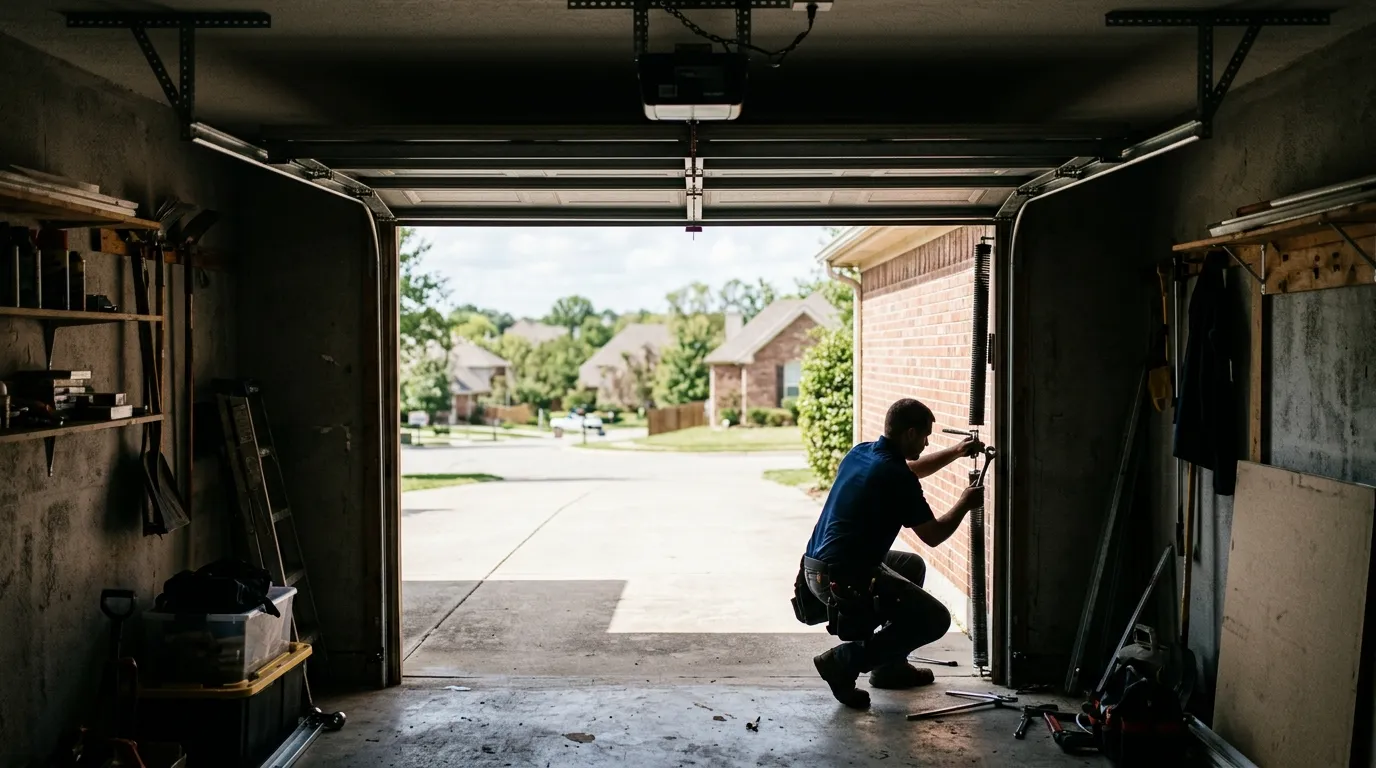
We run out of Sherman, and Bells sits about 12 miles down the road, close enough that a truck already on the way to Denison or Pottsboro can usually swing through the same day. We don't keep a shop or a crew stationed in Bells, so we won't pretend there's a depot around the corner. What we can say is that the drive itself isn't the bottleneck most days - parts availability for an older opener or a discontinued spring size is more often what sets the schedule. If you call and we're mid-job somewhere else on the list, we'll tell you honestly where you land in the queue rather than promise a window we can't hit.
Bells isn't one era of building stacked on itself the way some larger towns are. With 763 households in the area, it's a small enough footprint that a handful of subdivisions from the mid-1980s account for a lot of the doors we see, alongside newer infill built after 2000. That 1985 median build year matters more than it sounds like it should: it puts most garages right at the point where steel sectional doors and chain-drive openers had become standard, but before today's insulated panels and screw-drive or belt systems showed up. So a repair call here is often less about a dead opener board and more about a torsion spring or a track bent from age, on hardware that's been doing its job quietly for close to forty years.
A door installed around 1985 was built to a different set of expectations than one going in today. Panels tend to be thinner steel, insulation (if there's any) is minimal, and the springs were sized for the door weight of that era, not for a heavier retrofit insulated panel someone may have swapped in later without recalculating spring tension. In this cold-moderate climate, temperature swings between summer and winter put real stress on aging torsion springs and rollers that were never rubber-sealed to begin with. That combination - original-era hardware plus real seasonal temperature change - is why the failures we see most in this stretch of houses are spring breaks and roller wear, not opener electronics. Replacing a spring on a 40-year-old door is usually worth doing. Replacing the whole door is worth considering once the track and jambs have shifted enough that a new spring won't hold alignment.
Zoom out to the wider Sherman service area and you're looking at housing built between 1967 and 2005, with a median around 1984 across 14 named communities - Bells sits right in the middle of that range at 1985, not an outlier. Area household income here runs $89,635, higher than the roughly $74,773 median for the broader service area, which tends to show up in the calls we get as more owners opting for full replacement with a better-insulated door rather than patching an old one repeatedly. Across the wider area there are 20,213 households and 10,699 owner-occupied houses, and Bells' 763 households are a small but consistent slice of that. It's a town where the housing is old enough to have real hardware issues, but the households calling us are often ready to invest in doing it right the second time.
No. We work out of Sherman and drive out to Bells, about 12 miles each way. Most jobs still get same-day or next-day service, but we won't claim a local depot we don't have.
A lot of the housing here dates to around 1985, right when steel sectional doors and torsion springs became standard. Forty years of seasonal temperature swings in this cold-moderate climate wear those original springs down, so spring failure is the most common call we get from this area.
Depends on the door. If the track and jambs are still square, a new spring or roller set usually solves it. Once the frame has shifted from age or someone's added a heavier panel without upgrading the spring, repeated patching stops making sense and replacement is the better spend.
Call now or request a free quote - same-day service on most repairs, upfront written pricing.
A single dented panel on a sectional door can sometimes be swapped without touching the rest of the door, if the manufacturer still makes that panel and you can match the color and ridge profile. That's a big if in a town where the median house went up in 1977. Doors from that era were often steel or fiberglass in panel styles and mounting patterns that got discontinued decades ago, and the section width, hinge spacing, or track profile on a 1970s door frequently won't match anything sold today.
If you're set on trying it yourself, start by counting the hinges and measuring the panel height and width before you order anything, because guessing gets expensive fast. Removing the panel means disconnecting the door from spring tension, which is where most DIY jobs go wrong - the door can drop or the spring can let go under load. If the springs are original too, that's decades of cycles on hardware that was never meant to last this long. We'd rather talk you through what you're looking at over the phone before you pull anything apart than have you find out the hard way that the section doesn't come off clean.
With a median build year of 1977, a good share of Whitesboro's garage doors are older than the typical door across the wider Sherman service area, where most stock dates 1967 to 2005 with a median closer to 1984. That seven-year gap matters. It means more Whitesboro doors are still running original panels, original track, and in some cases original springs that were never upgraded when torsion hardware became standard.
What that looks like in practice: a bottom panel that's rusted through at the corners where water sits, a section that's bowed or oil-canned from decades of sun and cold cycling, or hinges that are stripped out because the screws have backed out and been retightened one too many times. On older steel doors, you'll often see the panel skin separating from the frame at the seams before the whole section fails outright. If the door is original to a 1977 build, there's a real chance the replacement panel simply doesn't exist anymore, and the fix is a new section built to fit the old track, or a full door.
This area sits in a cold-moderate climate band, which means garage doors go through real freeze-thaw cycling every winter and hot, humid stretches in summer. On a door that's been in place since the late 1970s, that's close to fifty years of expansion and contraction on the same steel skin and the same seams. Panels that were fine for the first thirty years start showing stress cracks and seam separation in the last ten, especially at the bottom section where moisture collects.
We also see corrosion at the panel edges where the original weatherstripping has hardened and stopped sealing, letting water sit against bare metal through the winter. Combine that with original hardware - hinges, rollers, sometimes the springs - and you get a door where one bad section is really a symptom of everything on it being the same age. Replacing just the panel can buy time, but if the rest of the door is from the same 1977 build, it's worth having someone look at the whole thing before you spend money twice.
We're honest about this part: Whitesboro is about sixteen miles from our Sherman shop, so the trip out is part of the job, not an afterthought. If the panel style is still made, a straightforward swap is usually a same-visit job once we're on site with the right part. If the door is old enough that the panel has to be custom-matched or the section built to fit discontinued track - which is common on doors from the 1970s - that part has to be ordered, and the door sits with a temporary brace or a secured section until it arrives.
We'd rather tell you that up front than promise a turnaround we can't back up on hardware this old. The honest limitation here is that we don't stock every discontinued panel profile, so on some original 1970s doors the wait is on the supplier, not on us. We'll tell you which situation you're in before we start, not after.
If your house dates near the 1977 median for the area, your door may be old enough that the manufacturer no longer makes that panel profile. We check the brand and section dimensions first - sometimes a match exists, sometimes we have to build a section to fit your original track instead.
No. We're based in Sherman and travel to Whitesboro, about sixteen miles away, for panel jobs. There's no local branch or depot here, so scheduling accounts for the drive rather than a walk-in visit.
Depends on the door's age and condition. If the rest of the sections, hinges, and springs are original to a 1970s build and showing the same wear, replacing one panel often just delays the next failure. We'll tell you honestly which situation you're in before you spend money.
Decades of freeze-thaw cycling in this cold-moderate climate on steel that's original to a house built around 1977. Seams separate, bottom corners rust where water collects, and hardened weatherstripping stops keeping moisture off the metal.