Sherman, TX · Garage Door Service
Sherman homes built mostly between 1967 and 2005 carry original hardware that wears out the same way. We fix springs, openers, and tracks built for that era.
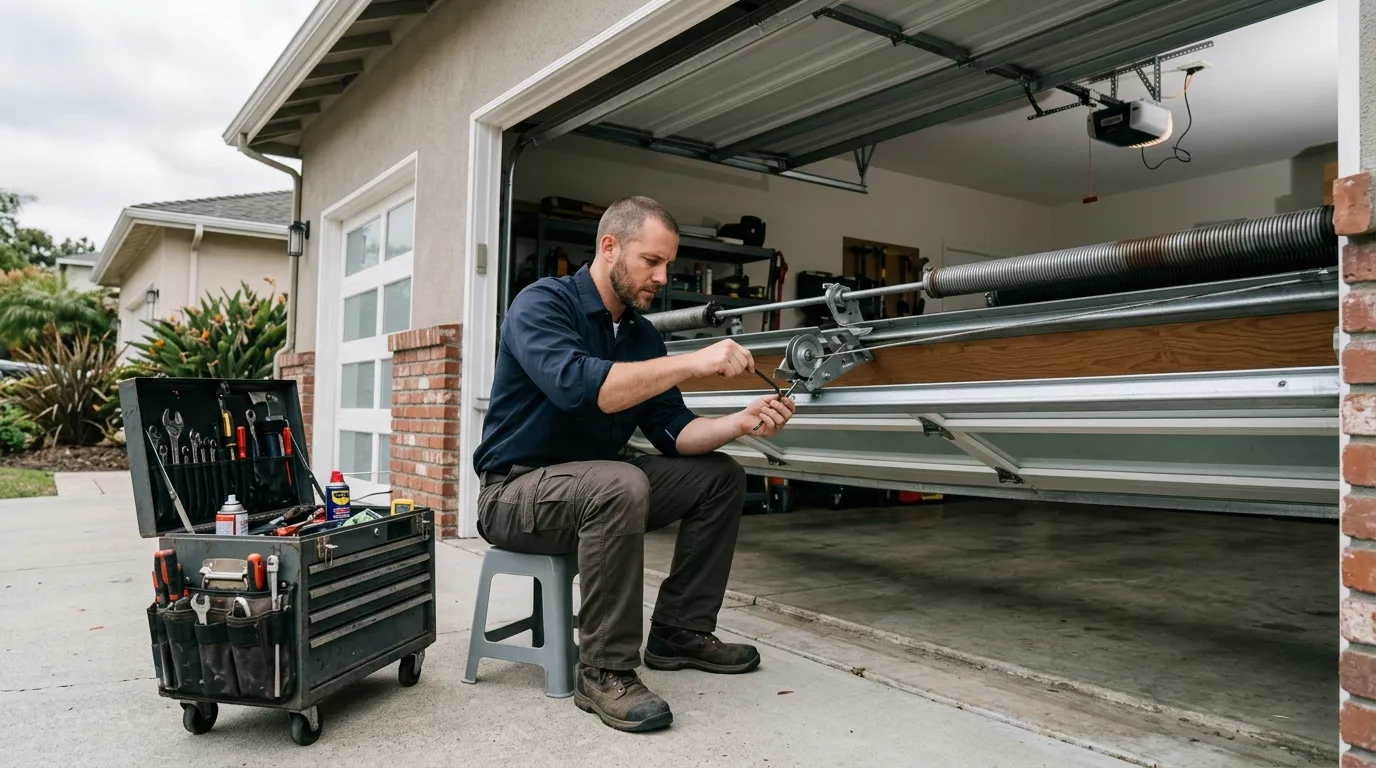
Most of the houses we get called to across Sherman went up somewhere between 1967 and 2005, with the median build year sitting around 1984. That matters because doors and openers installed during that stretch were built to a different standard than what's sold today - thinner steel, single torsion springs sized for lighter sections, and openers with gear sets that were never meant to run twenty or thirty years. Across the fourteen communities we work in, from Southmayd and Howe in close to Tioga and Savoy further out, that 1980s-90s stock is the norm, not the exception.
Our winters aren't brutal here, but the cold-moderate swing we get is enough to stiffen grease in old bearings and shrink steel tracks just enough to throw rollers out of alignment. A door that closes fine in August can start binding or dropping crooked in January because the same clearance tolerances that worked at 70 degrees don't hold at 30. On original hardware from the Reagan and Clinton eras, that seasonal shift is usually the thing that finally finishes off a spring or a worn roller that's been getting weaker for years. We see the pattern often enough that we can usually tell you what's wrong before we even open the panel.
Because so much of Sherman's garage door hardware dates back to that 1967-2005 build window, we keep stock sized for what's actually on these houses - not just whatever's newest on a supplier's shelf. That means torsion springs in the wind and wire sizes that match doors from that era, extension spring sets for the older detached garages that never got upgraded, and steel rollers and hinges built to hold up against repeated cold-to-warm cycling rather than just look good in a box.
We also carry standard replacement openers and drive components, since a lot of the original chain-drive units in this area are well past the point where a repair makes financial sense. One honest limitation: some of the oldest sectional doors - the ones from houses built in the late 1960s and early 70s - use panel widths and track profiles that nobody manufactures anymore. On those, we'll tell you straight if we can keep the door running with what's available or if the smarter move is a full replacement. We're not going to force a part that doesn't fit just to close the ticket.
If your door is loud on the way up, hesitates a few inches off the ground, or the opener runs but the door barely moves, you're looking at the same failure pattern we see across the fourteen areas we cover. A door that's uneven - one side higher than the other when it stops - almost always means one cable or spring on 1980s-era hardware has taken more load than its twin and is close to letting go.
A door that reverses right after it touches the floor, or won't fully seat, points to track alignment that's shifted with age, especially common on the original stock built through the 1990s. If the opener motor runs constantly but the door doesn't respond, that's usually a stripped gear inside a unit that's simply reached the end of its service life rather than a quick-fix problem. None of these are guesses pulled from nowhere - they're the specific symptoms that keep showing up on houses built in Sherman's main construction era, and they tell us where to start before a truck even leaves the yard.
For a spring failure on hardware from the 1967-2005 stock, the fix is a matched replacement pair sized to the door's actual weight, not a generic one-size spring pulled off a shelf - undersized springs are a big reason these doors fail again within a year or two. For alignment problems tied to seasonal cold-moderate shifts, we true up the tracks and replace worn rollers so the door isn't fighting itself every time the temperature swings.
On openers, if the unit is a chain-drive model original to a house built in that mid-80s window, we'll walk you through the real cost comparison: repair the gear now, or replace with something that'll outlast the next few winters. We serve the households in Sherman and the surrounding communities - out to Southmayd, Howe, Denison, Pottsboro, Tom Bean, Bells, Sadler, Van Alstyne, Savoy, Whitewright, Whitesboro, Collinsville, Gunter, and Tioga - and the fix we recommend depends on what's actually installed on your garage, not a standard package. We'll show you what's worn before we replace it.
Most homes here were built between 1967 and 2005, and a lot of that original torsion hardware is still in place. Springs have a rated lifecycle, and once a house passes 20-30 years old, that hardware is past or near its expected run, especially with the seasonal temperature swings our cold-moderate climate puts on the metal.
Yes, for most of the 1980s-90s stock that makes up the bulk of homes in our service area. On the small number of houses from the late 1960s with original, discontinued panel sizes, we'll tell you honestly whether a part fits or whether replacement is the better call.
We cover the households across Sherman and out to the surrounding communities, including Southmayd, Howe, Denison, Pottsboro, Tom Bean, Bells, Sadler, Van Alstyne, Savoy, Whitewright, Whitesboro, Collinsville, Gunter, and Tioga.
Sometimes, sometimes not. If it's a stripped gear on a unit that's otherwise sound, a repair can make sense. If the motor itself is failing on an opener that old, replacement usually costs less over time than repeated repair calls.
Call now or request a free quote - same-day service on most repairs, upfront written pricing.