Sherman, TX · Garage Door Service
Whitesboro homes date closer to 1977, a decade ahead of the wider Sherman service area's 1984 median. That older hardware is why doors jump track differently out here.
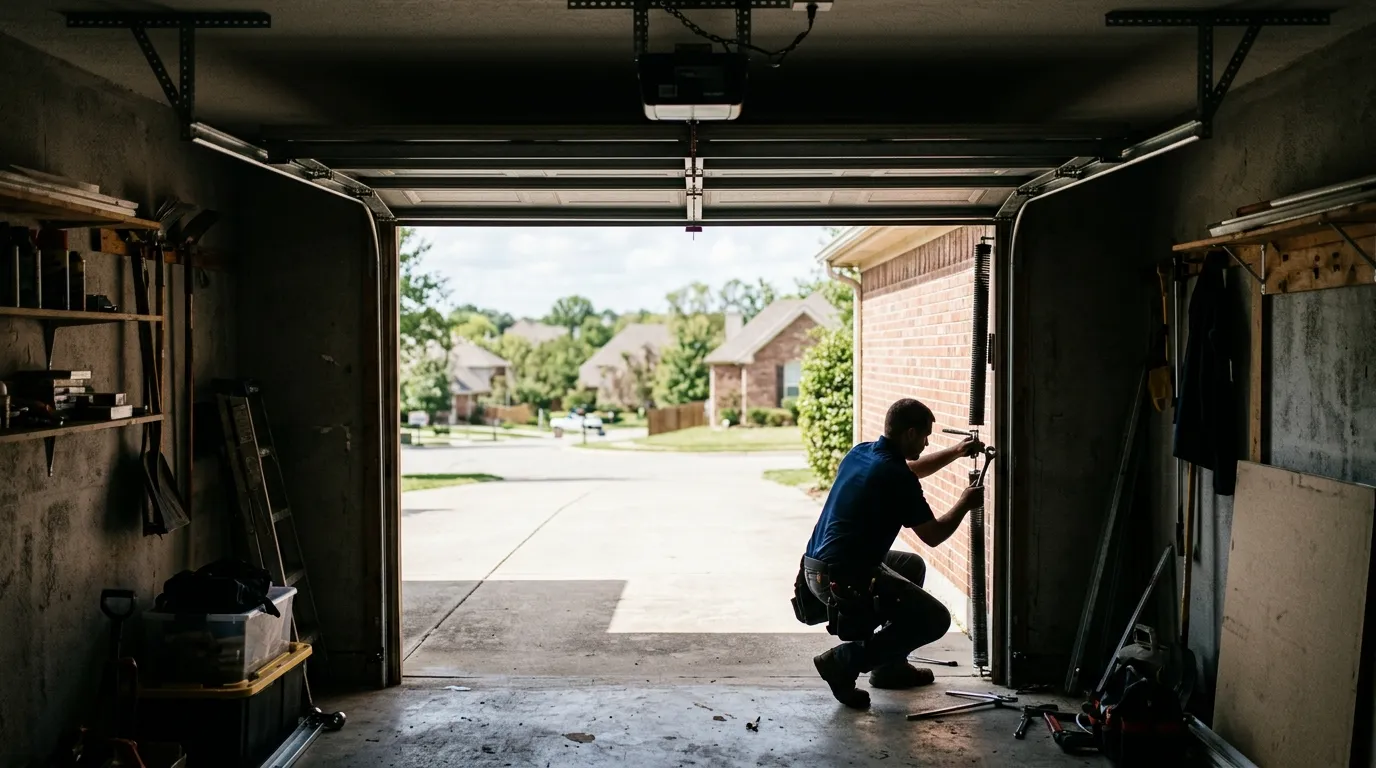
We run out of Sherman, and Bells sits about 12 miles down the road, close enough that a truck already on the way to Denison or Pottsboro can usually swing through the same day. We don't keep a shop or a crew stationed in Bells, so we won't pretend there's a depot around the corner. What we can say is that the drive itself isn't the bottleneck most days - parts availability for an older opener or a discontinued spring size is more often what sets the schedule. If you call and we're mid-job somewhere else on the list, we'll tell you honestly where you land in the queue rather than promise a window we can't hit.
Bells isn't one era of building stacked on itself the way some larger towns are. With 763 households in the area, it's a small enough footprint that a handful of subdivisions from the mid-1980s account for a lot of the doors we see, alongside newer infill built after 2000. That 1985 median build year matters more than it sounds like it should: it puts most garages right at the point where steel sectional doors and chain-drive openers had become standard, but before today's insulated panels and screw-drive or belt systems showed up. So a repair call here is often less about a dead opener board and more about a torsion spring or a track bent from age, on hardware that's been doing its job quietly for close to forty years.
A door installed around 1985 was built to a different set of expectations than one going in today. Panels tend to be thinner steel, insulation (if there's any) is minimal, and the springs were sized for the door weight of that era, not for a heavier retrofit insulated panel someone may have swapped in later without recalculating spring tension. In this cold-moderate climate, temperature swings between summer and winter put real stress on aging torsion springs and rollers that were never rubber-sealed to begin with. That combination - original-era hardware plus real seasonal temperature change - is why the failures we see most in this stretch of houses are spring breaks and roller wear, not opener electronics. Replacing a spring on a 40-year-old door is usually worth doing. Replacing the whole door is worth considering once the track and jambs have shifted enough that a new spring won't hold alignment.
Zoom out to the wider Sherman service area and you're looking at housing built between 1967 and 2005, with a median around 1984 across 14 named communities - Bells sits right in the middle of that range at 1985, not an outlier. Area household income here runs $89,635, higher than the roughly $74,773 median for the broader service area, which tends to show up in the calls we get as more owners opting for full replacement with a better-insulated door rather than patching an old one repeatedly. Across the wider area there are 20,213 households and 10,699 owner-occupied houses, and Bells' 763 households are a small but consistent slice of that. It's a town where the housing is old enough to have real hardware issues, but the households calling us are often ready to invest in doing it right the second time.
No. We work out of Sherman and drive out to Bells, about 12 miles each way. Most jobs still get same-day or next-day service, but we won't claim a local depot we don't have.
A lot of the housing here dates to around 1985, right when steel sectional doors and torsion springs became standard. Forty years of seasonal temperature swings in this cold-moderate climate wear those original springs down, so spring failure is the most common call we get from this area.
Depends on the door. If the track and jambs are still square, a new spring or roller set usually solves it. Once the frame has shifted from age or someone's added a heavier panel without upgrading the spring, repeated patching stops making sense and replacement is the better spend.
Call now or request a free quote - same-day service on most repairs, upfront written pricing.
An off-track garage door is not a DIY fix, and that goes double on a house built around 1977, which is closer to Whitesboro's median build year than the 1984 median across the wider Sherman service area. Older track brackets were often fastened straight to framing that's had forty-plus years to shift, dry out, or get re-shimmed by someone before you. If a roller has jumped the track, the door is under spring tension and the track itself may be pulled away from the jamb, not just misaligned. Pushing the door back onto the track by hand, or cranking on the opener to force it, can drop the door on you or bend the track past saving. If the door is only part-way off, one panel, one roller, leave it where it sits and call it in. If it's fully derailed and blocking the opening, don't try to muscle it upright. The one thing worth doing yourself: unplug or disconnect the opener so it doesn't try to drive a door that isn't riding true. Beyond that, this is a job for someone who can see whether it's the track, the roller, or the bracket that let go, because on a house this age it's often more than one of the three.
On a door built or replaced around the late 1970s, off-track almost always starts small: a roller that's worn oval instead of round, riding rough in the track until it catches an edge and hops out. You'll notice the door binding on one side before it fully derails, or a scraping sound that gets worse over a few weeks. Once it jumps, the panel above that roller usually leans, and the door won't seat flush at the bottom even if you get it moving again. On older two-car doors especially, a track that's slightly bowed from age will let the roller ride the edge instead of the channel, and that's a slow failure, not a sudden one. If your door came off the track after a hard stop or an opener that kept pulling against resistance, the bracket that holds the track to the frame may have pulled loose from wood that's had decades to season and loosen its grip on fasteners. Either way, the fix isn't the same repair every time, and a door that looks the same as its neighbor's can have a completely different cause underneath, depending on when the track and rollers were last replaced.
Whitesboro's housing runs older than the median for the areas Sherman Garage Door Pros covers, most of which sits closer to 1984. That decade gap matters for track failures specifically: track brackets and roller hardware from the late 1970s were built to a lighter standard than what's sold today, and after this many winters the steel fatigues at the mounting points first. This area sits in the same cold-moderate climate band as the rest of the region, and repeated freeze-thaw cycles work at wood-framed track brackets, loosening the lag screws a little more each season until a roller finally rides off the edge under normal use. It doesn't take a storm or a hard impact. A door that's opened and closed a few times a day for over forty years will eventually flex a track that was fine for the first thirty. Household incomes here, a median near $73,638, track close to the broader service area's figures, so this isn't a case of deferred maintenance from lack of means, it's the housing age doing what housing age does. Newer neighborhoods in Sherman's own more recently built areas don't see this pattern nearly as often.
We aren't based in Whitesboro. The truck comes from Sherman, about 16 miles out, so factor that drive into when the door gets back on track rather than expecting a same-hour fix. What actually decides the timeline once someone's on site is whether the track itself is salvageable or whether four decades of use has warped it past a re-hang. A bent section can sometimes be straightened and re-secured to solid framing the same visit. A track that's rusted through at the bracket points, which shows up more on houses from this build era, usually needs replacing outright, and that's a parts question as much as a labor one. We don't carry every gauge of track on the truck for a house this old, so if the section is obsolete or nonstandard, there may be a short wait on the part. That's the honest limit here: we can usually get the door safe and moving again same visit, but a full track replacement on older hardware sometimes means a second trip once the right part is in hand.
On houses from Whitesboro's era, yes, if the underlying cause, worn rollers or a loosened bracket, never got fixed the first time. Popping the door back on the track without addressing why it jumped just buys you a repeat visit. We look at the roller wear and the bracket fasteners, not just the immediate derail, so it doesn't happen again next month.
Sometimes. A mild bow from age can be pulled back and re-secured to solid framing. But track from the late 1970s that's rusted or fatigued at the mounting holes usually isn't worth straightening, it'll bow again sooner. We'll tell you honestly which one your door has before we quote a fix.
Not every gauge. Track and bracket hardware from this housing era isn't always the standard stock size, so if your section is nonstandard we may need to order it after the first visit. We'll get the door safe and functional the same day regardless, even if the permanent part takes a short wait.
About 16 miles from Sherman. We don't keep a branch or standing crew in Whitesboro itself, the truck comes out from Sherman for each call, so plan the drive time into your day rather than expecting an immediate arrival.