Sherman, TX · Garage Door Service
Whitesboro's 1,601 households sit mostly in homes built around 1977, older stock than much of Sherman's service area, and that changes what a new door install actually involves.
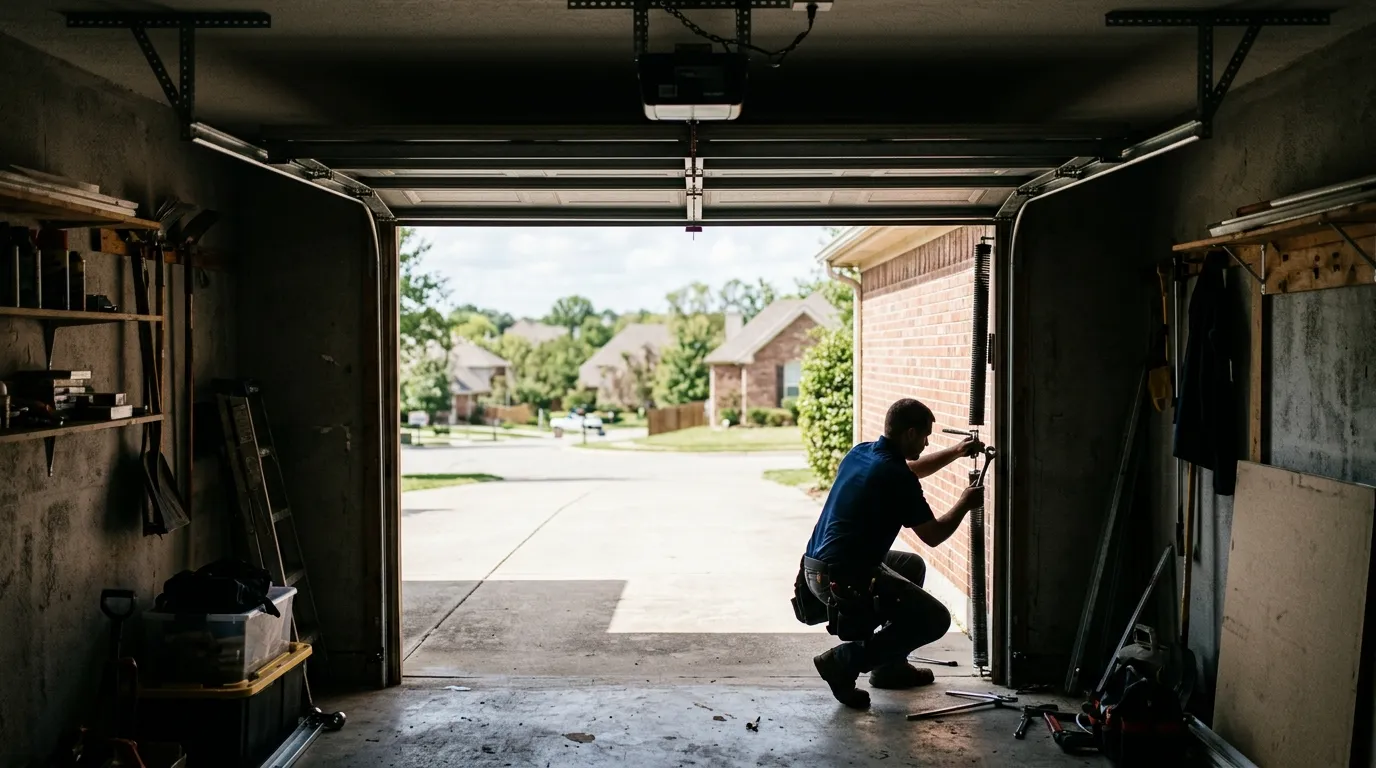
We run out of Sherman, and Bells sits about 12 miles down the road, close enough that a truck already on the way to Denison or Pottsboro can usually swing through the same day. We don't keep a shop or a crew stationed in Bells, so we won't pretend there's a depot around the corner. What we can say is that the drive itself isn't the bottleneck most days - parts availability for an older opener or a discontinued spring size is more often what sets the schedule. If you call and we're mid-job somewhere else on the list, we'll tell you honestly where you land in the queue rather than promise a window we can't hit.
Bells isn't one era of building stacked on itself the way some larger towns are. With 763 households in the area, it's a small enough footprint that a handful of subdivisions from the mid-1980s account for a lot of the doors we see, alongside newer infill built after 2000. That 1985 median build year matters more than it sounds like it should: it puts most garages right at the point where steel sectional doors and chain-drive openers had become standard, but before today's insulated panels and screw-drive or belt systems showed up. So a repair call here is often less about a dead opener board and more about a torsion spring or a track bent from age, on hardware that's been doing its job quietly for close to forty years.
A door installed around 1985 was built to a different set of expectations than one going in today. Panels tend to be thinner steel, insulation (if there's any) is minimal, and the springs were sized for the door weight of that era, not for a heavier retrofit insulated panel someone may have swapped in later without recalculating spring tension. In this cold-moderate climate, temperature swings between summer and winter put real stress on aging torsion springs and rollers that were never rubber-sealed to begin with. That combination - original-era hardware plus real seasonal temperature change - is why the failures we see most in this stretch of houses are spring breaks and roller wear, not opener electronics. Replacing a spring on a 40-year-old door is usually worth doing. Replacing the whole door is worth considering once the track and jambs have shifted enough that a new spring won't hold alignment.
Zoom out to the wider Sherman service area and you're looking at housing built between 1967 and 2005, with a median around 1984 across 14 named communities - Bells sits right in the middle of that range at 1985, not an outlier. Area household income here runs $89,635, higher than the roughly $74,773 median for the broader service area, which tends to show up in the calls we get as more owners opting for full replacement with a better-insulated door rather than patching an old one repeatedly. Across the wider area there are 20,213 households and 10,699 owner-occupied houses, and Bells' 763 households are a small but consistent slice of that. It's a town where the housing is old enough to have real hardware issues, but the households calling us are often ready to invest in doing it right the second time.
No. We work out of Sherman and drive out to Bells, about 12 miles each way. Most jobs still get same-day or next-day service, but we won't claim a local depot we don't have.
A lot of the housing here dates to around 1985, right when steel sectional doors and torsion springs became standard. Forty years of seasonal temperature swings in this cold-moderate climate wear those original springs down, so spring failure is the most common call we get from this area.
Depends on the door. If the track and jambs are still square, a new spring or roller set usually solves it. Once the frame has shifted from age or someone's added a heavier panel without upgrading the spring, repeated patching stops making sense and replacement is the better spend.
Call now or request a free quote - same-day service on most repairs, upfront written pricing.
A new garage door install looks simple until you're holding a 150-pound section over your head with no second set of hands. With only 1,601 households in Whitesboro, this isn't a town where every third house has had a crew through recently, so a lot of homeowners here are working from the original door and original opener with no record of what track spacing or spring size the house was built with. That matters. Get the header height wrong, or mismatch a torsion spring to the wrong door weight, and you've got a door that slams down or won't lift past chest height. We're honest that the panel-hanging part of a two-car door is a two-person job minimum, and the spring conversion on an older jamb is not a Saturday project for most people. If you want to swap a slab door yourself, fine - but have someone who's done a torsion changeover check the drum spacing before you walk away from it. That's the part that hurts a hand or a ceiling if it's off.
With a median build year around 1977, a good share of Whitesboro's garage doors are original or close to it - steel sectional doors on jambs that were framed before insulated doors and rolling-code openers were standard. What that means for an install: door openings here often run narrower or shorter than what a big-box store's standard-size door assumes, so a straight swap without measuring the actual jamb can leave you with a gap at the header or a track that has to be re-bent to fit. You'll also see a lot of single-torsion-spring setups on doors that, by today's weight tables, should run two springs. None of that is a defect - it's just what a house built in the late '70s came with, and it's the starting point for sizing a new door correctly rather than assuming the old numbers still apply.
This area sits in a cold-moderate climate band, which means real freeze-thaw cycling through winter rather than the deep-freeze extremes you'd get farther north. On a door installed decades ago, that cycling works on the weatherstripping and the bottom seal first - they harden, crack, and stop sealing years before the panels themselves fail. A new install done right accounts for that seal and for a door bottom that can flex slightly with ground movement instead of binding on the track. Beyond the weather, the other driver is simply age: hardware and springs from a house built around 1977 are past their designed cycle count on torsion springs and often on rollers too, so a new door usually means new lift hardware as well, not just a new slab bolted onto the old track.
We run out of Sherman, about 16 miles from Whitesboro, so the install day itself is planned as a single trip - we're not stopping back twice for something that should've been measured the first time. Most straight-forward sectional installs are a one-day job: old door and track out, new jamb hardware set, new door and opener hung and balanced before we leave. Where it runs longer is when the original 1970s-era jamb needs framing work to square it for a modern door, or when a non-standard opening means the new door has to be special-ordered rather than pulled off a shelf - that's a lead-time issue on the door itself, not something we can shortcut. We'll tell you upfront if your opening falls into that category before any work starts, not after.
Often, but not automatically. A lot of Whitesboro garages were framed around 1977, before today's standard door sizes were common, so we measure the actual jamb rather than assume a stock-size door will drop straight in. If the opening is non-standard, the door has to be ordered to fit, which affects the timeline.
No. Sherman Garage Door Pros is based in Sherman, about 16 miles away, and we travel out to Whitesboro for installs. We plan the job as a single trip rather than multiple visits, but we don't have a local branch or standing crew in town.
If your house dates to the 1977 era, the opener is very likely original or close to it, and it wasn't engineered for a heavier insulated door. We'll check the opener's lift rating against the new door's weight before install and tell you honestly if it needs replacing alongside the door.
It can be. A lot of older Whitesboro doors run one torsion spring where current weight tables call for two, especially on double-wide doors. When we install a new door, we size the spring count to the new door's actual weight rather than reuse whatever was on the jamb before.