Sherman, TX · Garage Door Service
Serving Whitesboro's mostly 1970s-era homes from Sherman, 16 miles out. Torsion and extension spring repair, opener fixes, and track work for older door hardware.
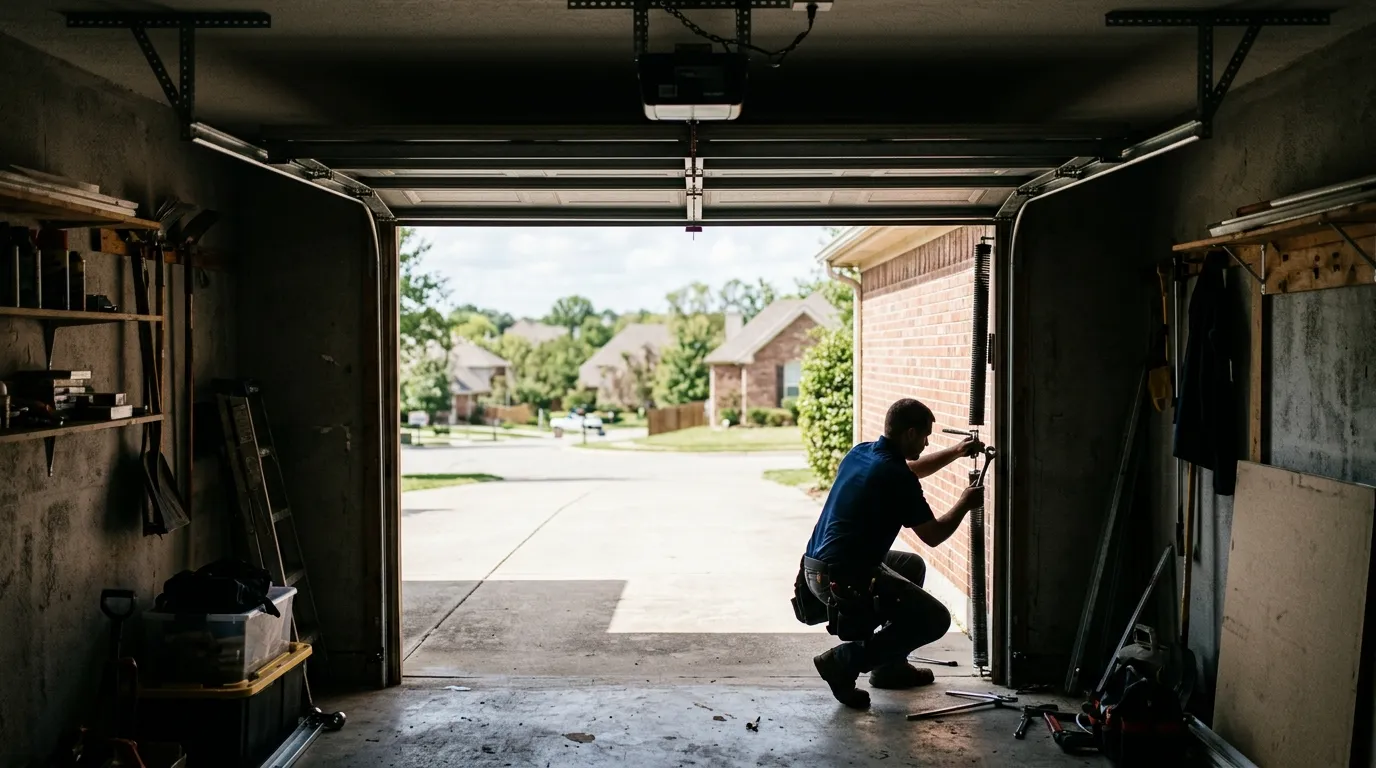
We run out of Sherman, and Bells sits about 12 miles down the road, close enough that a truck already on the way to Denison or Pottsboro can usually swing through the same day. We don't keep a shop or a crew stationed in Bells, so we won't pretend there's a depot around the corner. What we can say is that the drive itself isn't the bottleneck most days - parts availability for an older opener or a discontinued spring size is more often what sets the schedule. If you call and we're mid-job somewhere else on the list, we'll tell you honestly where you land in the queue rather than promise a window we can't hit.
Bells isn't one era of building stacked on itself the way some larger towns are. With 763 households in the area, it's a small enough footprint that a handful of subdivisions from the mid-1980s account for a lot of the doors we see, alongside newer infill built after 2000. That 1985 median build year matters more than it sounds like it should: it puts most garages right at the point where steel sectional doors and chain-drive openers had become standard, but before today's insulated panels and screw-drive or belt systems showed up. So a repair call here is often less about a dead opener board and more about a torsion spring or a track bent from age, on hardware that's been doing its job quietly for close to forty years.
A door installed around 1985 was built to a different set of expectations than one going in today. Panels tend to be thinner steel, insulation (if there's any) is minimal, and the springs were sized for the door weight of that era, not for a heavier retrofit insulated panel someone may have swapped in later without recalculating spring tension. In this cold-moderate climate, temperature swings between summer and winter put real stress on aging torsion springs and rollers that were never rubber-sealed to begin with. That combination - original-era hardware plus real seasonal temperature change - is why the failures we see most in this stretch of houses are spring breaks and roller wear, not opener electronics. Replacing a spring on a 40-year-old door is usually worth doing. Replacing the whole door is worth considering once the track and jambs have shifted enough that a new spring won't hold alignment.
Zoom out to the wider Sherman service area and you're looking at housing built between 1967 and 2005, with a median around 1984 across 14 named communities - Bells sits right in the middle of that range at 1985, not an outlier. Area household income here runs $89,635, higher than the roughly $74,773 median for the broader service area, which tends to show up in the calls we get as more owners opting for full replacement with a better-insulated door rather than patching an old one repeatedly. Across the wider area there are 20,213 households and 10,699 owner-occupied houses, and Bells' 763 households are a small but consistent slice of that. It's a town where the housing is old enough to have real hardware issues, but the households calling us are often ready to invest in doing it right the second time.
No. We work out of Sherman and drive out to Bells, about 12 miles each way. Most jobs still get same-day or next-day service, but we won't claim a local depot we don't have.
A lot of the housing here dates to around 1985, right when steel sectional doors and torsion springs became standard. Forty years of seasonal temperature swings in this cold-moderate climate wear those original springs down, so spring failure is the most common call we get from this area.
Depends on the door. If the track and jambs are still square, a new spring or roller set usually solves it. Once the frame has shifted from age or someone's added a heavier panel without upgrading the spring, repeated patching stops making sense and replacement is the better spend.
Call now or request a free quote - same-day service on most repairs, upfront written pricing.
Whitesboro's median home was built around 1977, which puts a lot of doors here on original or first-generation hardware - steel sectional doors set up with extension springs mounted along the horizontal track, or an early torsion bar bolted straight to the header with no safety cable running through the coils. That last detail matters: a bare torsion spring under tension can put a coil through drywall or a hand if it lets go while you're loosening the winding cone. Anything spring-related - torsion or extension, replacing either or adjusting tension - isn't a homeowner job on a door this age. What you can reasonably do yourself: tighten loose hinge bolts, clean and lubricate rollers, check that the track is still parallel to the door, and test the auto-reverse by laying a 2x4 flat under the door and closing it. If it doesn't bounce back, stop using the opener until someone looks at it. We work out of Sherman, about 16 miles away, so there's no local branch to walk into - if you call, expect to be scheduling a visit rather than dropping by a counter.
One honest limit: if the door itself is original steel from the late 70s and the panels are rusted through or the seams are separated, we're not going to spend an hour chasing a spring adjustment on a door that needs replacing anyway.
With a median build year of 1977, most of the roughly 1,601 households in Whitesboro are sitting on doors and openers that have been through at least one full replacement cycle, sometimes two. The most common calls we get from this stretch of homes: extension springs that have stretched past their coil spacing and no longer lift the door evenly, chain-drive openers from an earlier retrofit that grind or skip a link, and track that's pulled away from the framing because the original lag bolts were set into wood that's had forty-plus years to shrink. You'll also see a fair number of doors where one side lifts a beat before the other - a sign the two extension springs are no longer matched in tension, which happens gradually and then all at once. If your door reverses direction on its own partway up, or the opener hums but the door doesn't move, that's almost always a spring problem wearing an opener's symptoms. Sagging in the middle of a wide double door, especially on older lightweight steel, points to a bent track section rather than anything electrical.
This area sits in a cold-moderate climate band, and that shows up in spring behavior more than almost anything else. Steel springs lose a measurable amount of tension as temperature drops - a spring that's been marginal all summer will often finally give out on the first hard cold morning of the season, because the metal is stiffer and the door is heavier to lift than the spring can manage. Openers show a similar pattern: a chain drive that's been slipping quietly for months will jump or bind once cold tightens up the metal housing and thickens the old grease inside the gearbox. On the older 1970s-era doors still running extension springs instead of torsion, the cold makes the failure sudden rather than gradual - one spring snaps clean instead of stretching out slowly, and the door drops unevenly on one side. None of this is storm damage or anything dramatic. It's ordinary temperature swing acting on hardware that was already near the end of its working life.
Because we run out of Sherman, 16 miles from Whitesboro, factor drive time into how you plan the day - we're not going to beat a same-block company on arrival speed, and we won't pretend otherwise. Once we're on site, most spring and opener repairs on these older doors are a single visit: springs, cables, rollers, and standard opener parts are things we carry on the truck. Where it slows down is parts specific to an original 1970s door - some panel sections and older track hardware in that size and gauge aren't stocked anywhere local and have to be special-ordered, which can add days rather than hours. If a spring has snapped and the door is stuck down, it's safe to leave it closed and wait for the appointment; if it's stuck open, block the opening rather than trying to force it down manually on unmatched springs.
Cold makes steel stiffer and increases the load a spring has to lift. A spring that's been slowly weakening for months often holds fine through warm weather, then fails outright the first cold snap of the season because it's finally being asked for more tension than it has left. It's wear, not damage from the cold itself.
No. We're based in Sherman, about 16 miles away, and travel out for calls. There's no local counter or drop-in shop here, so repairs are scheduled visits rather than walk-ins.
It's possible, especially if it's still running extension springs mounted along the horizontal track rather than a torsion spring over the header. If nobody's replaced the door or opener, original steel from that era is usually near the end of its service life and worth having looked at even if it's still working.
On a two-spring extension setup, we generally don't recommend it - springs age together, and pairing a new spring with a worn one puts uneven load on the door and often causes the exact one-side-lifts-first symptom that brought you to us in the first place.