Sherman, TX · Garage Door Service
Pottsboro homes built around 1991 still run steel rollers on steel track. We replace worn rollers with sealed nylon, traveling 10 miles from Sherman.
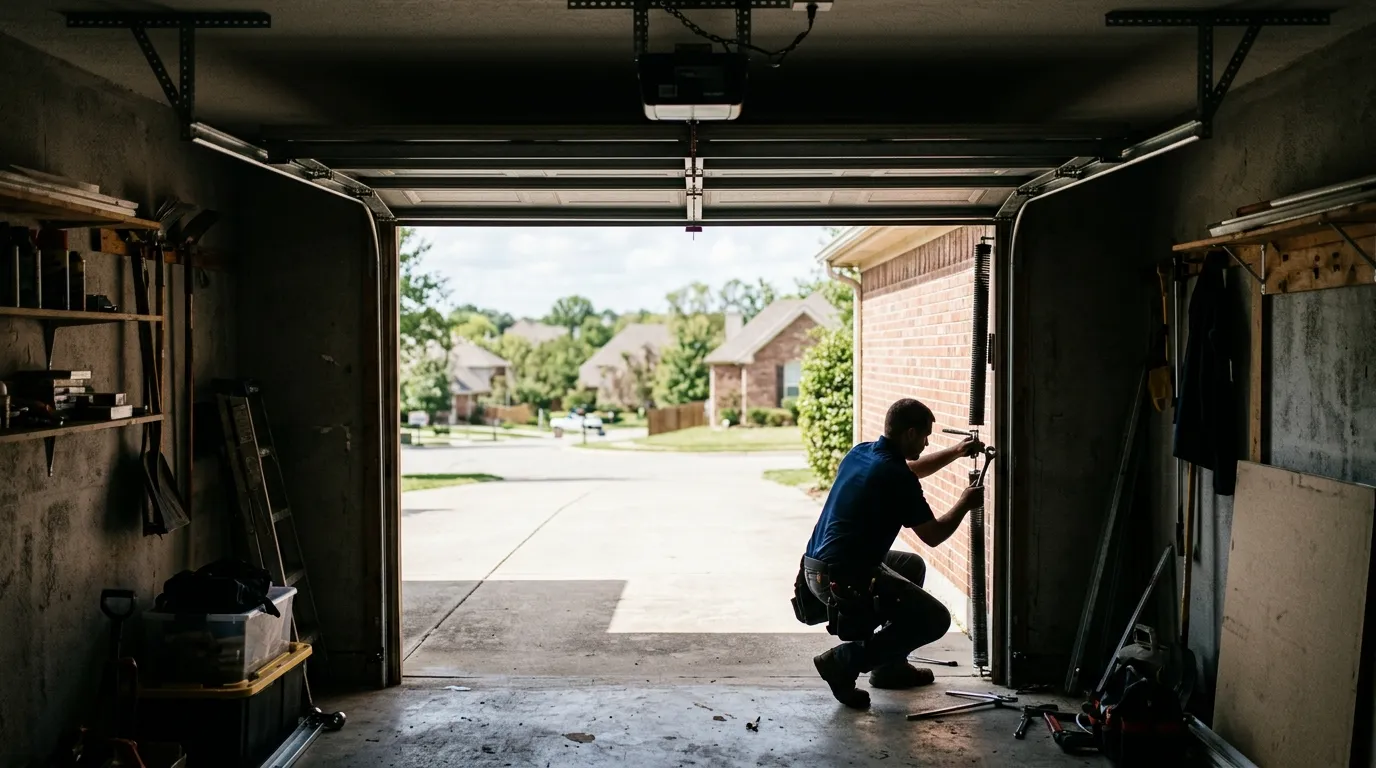
We run out of Sherman, and Bells sits about 12 miles down the road, close enough that a truck already on the way to Denison or Pottsboro can usually swing through the same day. We don't keep a shop or a crew stationed in Bells, so we won't pretend there's a depot around the corner. What we can say is that the drive itself isn't the bottleneck most days - parts availability for an older opener or a discontinued spring size is more often what sets the schedule. If you call and we're mid-job somewhere else on the list, we'll tell you honestly where you land in the queue rather than promise a window we can't hit.
Bells isn't one era of building stacked on itself the way some larger towns are. With 763 households in the area, it's a small enough footprint that a handful of subdivisions from the mid-1980s account for a lot of the doors we see, alongside newer infill built after 2000. That 1985 median build year matters more than it sounds like it should: it puts most garages right at the point where steel sectional doors and chain-drive openers had become standard, but before today's insulated panels and screw-drive or belt systems showed up. So a repair call here is often less about a dead opener board and more about a torsion spring or a track bent from age, on hardware that's been doing its job quietly for close to forty years.
A door installed around 1985 was built to a different set of expectations than one going in today. Panels tend to be thinner steel, insulation (if there's any) is minimal, and the springs were sized for the door weight of that era, not for a heavier retrofit insulated panel someone may have swapped in later without recalculating spring tension. In this cold-moderate climate, temperature swings between summer and winter put real stress on aging torsion springs and rollers that were never rubber-sealed to begin with. That combination - original-era hardware plus real seasonal temperature change - is why the failures we see most in this stretch of houses are spring breaks and roller wear, not opener electronics. Replacing a spring on a 40-year-old door is usually worth doing. Replacing the whole door is worth considering once the track and jambs have shifted enough that a new spring won't hold alignment.
Zoom out to the wider Sherman service area and you're looking at housing built between 1967 and 2005, with a median around 1984 across 14 named communities - Bells sits right in the middle of that range at 1985, not an outlier. Area household income here runs $89,635, higher than the roughly $74,773 median for the broader service area, which tends to show up in the calls we get as more owners opting for full replacement with a better-insulated door rather than patching an old one repeatedly. Across the wider area there are 20,213 households and 10,699 owner-occupied houses, and Bells' 763 households are a small but consistent slice of that. It's a town where the housing is old enough to have real hardware issues, but the households calling us are often ready to invest in doing it right the second time.
No. We work out of Sherman and drive out to Bells, about 12 miles each way. Most jobs still get same-day or next-day service, but we won't claim a local depot we don't have.
A lot of the housing here dates to around 1985, right when steel sectional doors and torsion springs became standard. Forty years of seasonal temperature swings in this cold-moderate climate wear those original springs down, so spring failure is the most common call we get from this area.
Depends on the door. If the track and jambs are still square, a new spring or roller set usually solves it. Once the frame has shifted from age or someone's added a heavier panel without upgrading the spring, repeated patching stops making sense and replacement is the better spend.
Call now or request a free quote - same-day service on most repairs, upfront written pricing.
Most garage doors in Pottsboro went up around 1991, a decade or so after the broader Sherman service area's median build year of 1984. That gap matters for rollers. A door from the early '90s almost always came with steel rollers riding in steel track - cheap to build, loud from day one, and they wear a groove into the track's face over the years rather than staying round. There's no rubber or nylon buffer, so every open and close is metal on metal.
On a 10-mile trip from Sherman, we see the same pattern house after house in Pottsboro: stems worn thin where they meet the roller housing, and bearings that seized up years ago and just kept grinding. Winters here fall in the cold-moderate band, and cold steel contracts - a track that's a hair out of plumb in July can bind a roller stem hard in January, which speeds up the wear on doors already thirty-plus years old.
If the roller stem has worn thin, you'll hear a rattle that gets worse the higher the door travels, because the stem is flexing in the bracket instead of sliding clean. A roller with a flat spot - from sitting in one position for months between uses - thumps once per rotation, a steady beat you can time with the door's speed.
Steel rollers that have lost their factory grease grind instead of roll; you'll see black dust on the track and on the floor under it. And if a roller has actually cracked or the bearing has seized solid, the door will hang up in the track at that spot every single time, sometimes hard enough to walk the door off the rail. None of these show up on a young door - they're specific to the age of hardware most Pottsboro garages are still running.
Rollers on the bottom two panels are within reach for most people with the door disconnected from the opener and the track sections separated carefully. That's not the same as the rollers higher up. On a lot of these 1991-era doors the top roller sits inside the same bracket that anchors the torsion spring's stationary cone, and the spring is under full tension the moment the door is closed.
We'll be straight about the limit here: if a stem has snapped off flush with the roller housing, or the track itself is bent from the roller binding in it, that's not a five-minute swap - you're pulling a section of track and possibly re-setting cable, and one wrong move near a wound spring can take a hand off. If it's a bottom roller and the door's disconnected and grounded, go ahead. Anything near the top brackets, call it in.
For doors of this vintage we carry sealed nylon rollers in the stem lengths that fit '90s-era steel track - 4-inch and 7-inch stems cover nearly everything we run into out this way. Nylon runs quieter than the original steel and doesn't need the periodic oiling steel does, which matters in a cold-moderate climate where grease stiffens up in January and gets sticky by August.
We stock standard 2-inch and 3-inch roller wheel sizes and the common bracket hardware that holds them, but we don't stock every obscure stem-and-wheel combination on the shelf - a nonstandard size on an older or modified door may mean a short order delay before we finish the job.
We run this job out of Sherman, about 10 miles from Pottsboro, and roller replacement is a same-visit repair once we're on site with the right stem length and wheel size for your door. Tell us the door's age if you know it - knowing it's a 1991-era build with steel track lets us bring the right nylon rollers the first time instead of making a second trip. See more on our [Pottsboro garage doors page](/pottsboro-garage-doors/), or check the general [roller replacement job in Sherman](/garage-door-roller-replacement-sherman-tx) for how we price and run the work.
We don't have a Pottsboro-specific number to quote you here, and we're not going to invent one. What we can tell you is that a full 10-roller set with sealed nylon costs more up front than steel but runs quieter and lasts longer, which matters if you're not planning to touch the door again for a decade. Households in this area report a median income of $75,909, in line with the wider Sherman service area's $74,773 - most owners we talk to treat a roller job as routine maintenance on a paid-off door rather than a big-ticket decision. Ask us for a number when we're on site; it depends on stem length, wheel size, and whether the track needs any straightening at the same time.
Steel rollers on steel track, which is what most doors built around 1991 have in Pottsboro, wear a groove into the track over decades and lose their factory grease. Without a buffer between metal and metal, that wear turns into a grinding or rattling noise that gets louder the older the hardware gets.
We carry sealed nylon rollers in the common 4-inch and 7-inch stem lengths that fit the steel track typical of doors from this era, plus standard 2-inch and 3-inch wheels. A nonstandard stem or wheel size on a modified door may need a short-order delay.
On the bottom two panels, yes, once the door is disconnected from the opener. Rollers near the top brackets often sit close to the torsion spring's stationary cone, and that spring holds full tension even with the door closed - that part of the job is not a do-it-yourself repair.
About 10 miles. We don't keep a separate branch or crew based in Pottsboro, so we schedule the trip from Sherman and bring roller stock sized for the steel track common on doors built in the early 1990s here.