Sherman, TX · Garage Door Service
Opener installs for Pottsboro's 1991-median housing stock, driven out from Sherman 10 miles away. We match hardware to what these garages were actually built with.
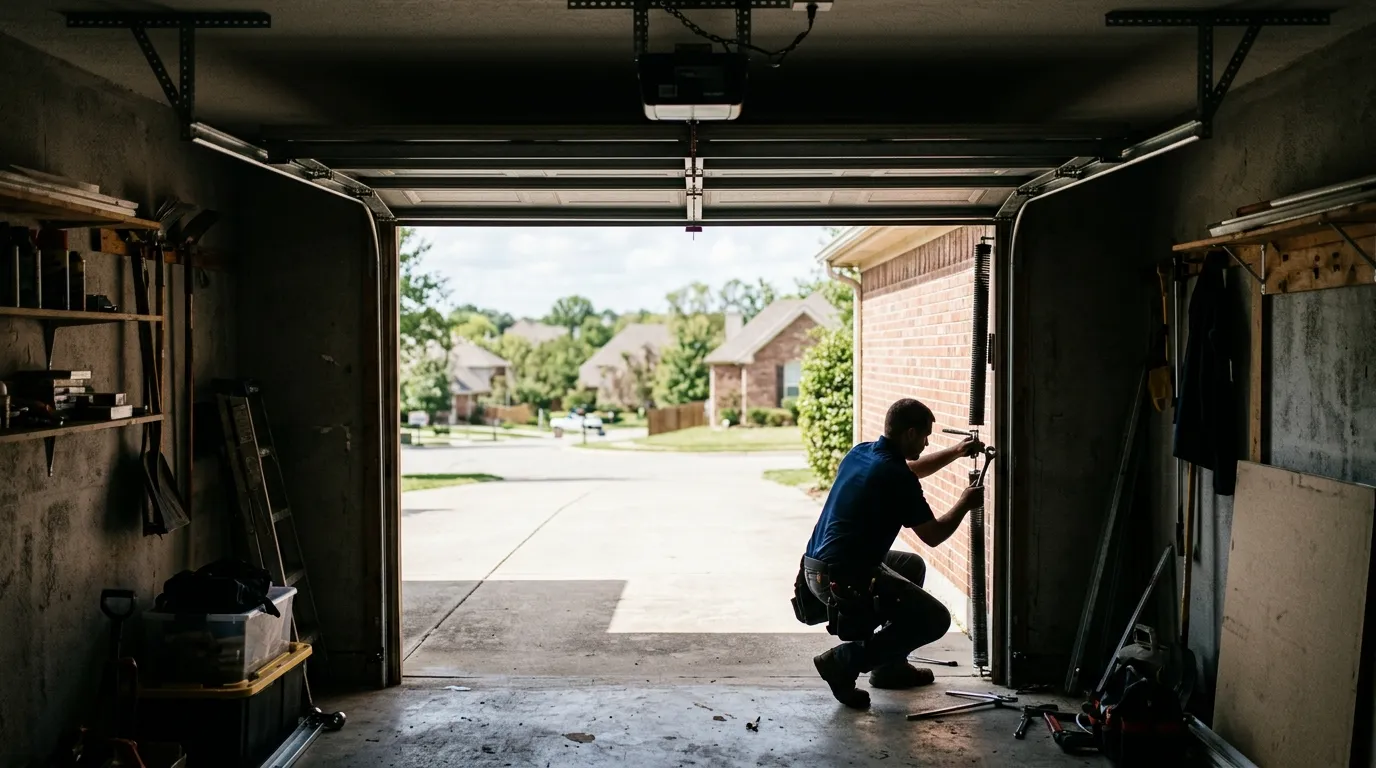
We run out of Sherman, and Bells sits about 12 miles down the road, close enough that a truck already on the way to Denison or Pottsboro can usually swing through the same day. We don't keep a shop or a crew stationed in Bells, so we won't pretend there's a depot around the corner. What we can say is that the drive itself isn't the bottleneck most days - parts availability for an older opener or a discontinued spring size is more often what sets the schedule. If you call and we're mid-job somewhere else on the list, we'll tell you honestly where you land in the queue rather than promise a window we can't hit.
Bells isn't one era of building stacked on itself the way some larger towns are. With 763 households in the area, it's a small enough footprint that a handful of subdivisions from the mid-1980s account for a lot of the doors we see, alongside newer infill built after 2000. That 1985 median build year matters more than it sounds like it should: it puts most garages right at the point where steel sectional doors and chain-drive openers had become standard, but before today's insulated panels and screw-drive or belt systems showed up. So a repair call here is often less about a dead opener board and more about a torsion spring or a track bent from age, on hardware that's been doing its job quietly for close to forty years.
A door installed around 1985 was built to a different set of expectations than one going in today. Panels tend to be thinner steel, insulation (if there's any) is minimal, and the springs were sized for the door weight of that era, not for a heavier retrofit insulated panel someone may have swapped in later without recalculating spring tension. In this cold-moderate climate, temperature swings between summer and winter put real stress on aging torsion springs and rollers that were never rubber-sealed to begin with. That combination - original-era hardware plus real seasonal temperature change - is why the failures we see most in this stretch of houses are spring breaks and roller wear, not opener electronics. Replacing a spring on a 40-year-old door is usually worth doing. Replacing the whole door is worth considering once the track and jambs have shifted enough that a new spring won't hold alignment.
Zoom out to the wider Sherman service area and you're looking at housing built between 1967 and 2005, with a median around 1984 across 14 named communities - Bells sits right in the middle of that range at 1985, not an outlier. Area household income here runs $89,635, higher than the roughly $74,773 median for the broader service area, which tends to show up in the calls we get as more owners opting for full replacement with a better-insulated door rather than patching an old one repeatedly. Across the wider area there are 20,213 households and 10,699 owner-occupied houses, and Bells' 763 households are a small but consistent slice of that. It's a town where the housing is old enough to have real hardware issues, but the households calling us are often ready to invest in doing it right the second time.
No. We work out of Sherman and drive out to Bells, about 12 miles each way. Most jobs still get same-day or next-day service, but we won't claim a local depot we don't have.
A lot of the housing here dates to around 1985, right when steel sectional doors and torsion springs became standard. Forty years of seasonal temperature swings in this cold-moderate climate wear those original springs down, so spring failure is the most common call we get from this area.
Depends on the door. If the track and jambs are still square, a new spring or roller set usually solves it. Once the frame has shifted from age or someone's added a heavier panel without upgrading the spring, repeated patching stops making sense and replacement is the better spend.
Call now or request a free quote - same-day service on most repairs, upfront written pricing.
Most opener calls we take in Pottsboro start the same way: a chain-drive unit from the original build finally gives out. The median home here went up around 1991, and builders in that stretch put in the cheapest 1/3-horsepower chain drives on the market, wired straight to a wall switch with no safety reversing sensors worth trusting. Thirty-plus years later, the gears inside those units are plastic, and plastic gears strip. That's the fault, not the door itself.
Because so much of the stock here dates to the same decade, we see the same failure over and over: a motor that hums but won't lift, or a unit that lifts halfway and reverses. It's not random. It's the age of the machine, not bad luck. Cold snaps make it worse - grease inside an old gearbox stiffens up, and a motor that was already struggling now can't break the door free on the first pull.
If your opener clicks and the light blinks but the carriage doesn't move, that's usually the drive gear stripped inside the housing - common on units this old. If the door reverses a few inches off the floor with no obstruction, the down-force setting has drifted, which happens as the whole unit ages and the spring balance shifts with it. A remote that only works standing under the unit points to a dying antenna board, another part that just wears out on this timeline.
We also get calls where the opener runs fine but the door is slow or jerky - that's rarely the opener itself. It's usually the springs or rollers on a 30-plus-year-old door working against a healthy motor. Worth mentioning before you assume you need a new opener.
Mounting a new opener bracket and running the rail isn't hard mechanically. The part that goes wrong is the force and travel-limit adjustment, and on an older door with worn springs, an opener set too aggressive can pull the top panel or snap a cable. We also see DIY installs skip the safety reversing sensors entirely because the old mounting holes don't line up with new brackets - that's a code issue, not a preference.
If you're comfortable with basic wiring and have a helper to hold the rail level while you set the limits, a straightforward swap on a door in decent shape is doable. If your springs are original to a 1991-era build, we'd rather you call before you put a new motor on old hardware that's about to fail anyway.
For the chain and belt-drive units common on Pottsboro's mostly 1980s-90s stock, we stock standard 1/2-horsepower replacement motors, new logic boards, and safety sensor pairs that fit the older door heights without re-drilling jambs. Belt drives for anyone wanting a quieter unit than the original chain-drive setup are on the truck too.
What we don't carry: openers built for oversized commercial doors or specialty low-headroom brackets for garages with unusual ceiling clearance. Those are special-order and we'll tell you upfront if that's what you need, rather than jam in something that won't hold up.
We run this job out of Sherman, about 10 miles up the road, so we schedule Pottsboro opener installs on the same routes as our other calls out that way. Tell us the opener brand and age if you know it, and whether the door is original to the house - that alone tells us which springs and brackets we're likely dealing with before we show up. See more on [Pottsboro garage doors](/pottsboro-garage-doors/) or the full opener install writeup for [Sherman](/garage-door-opener-installation-sherman-tx).
We don't have a set price to quote here without seeing the door - a straight motor swap on a working rail costs less than a full install with new safety sensors and a rewired wall switch, and doors from the early 90s often need both by now. What we can tell you is that Pottsboro's median household income, at $75,909, tracks close to the wider Sherman service area's $74,773, so pricing here isn't different from what we quote elsewhere - it's the age and condition of the door driving the number, not the zip code.
Cold thickens the grease in an aging gearbox and stiffens the spring steel that helps lift the door. On a unit already worn from decades of use, that extra resistance is often what finally causes a strip or a stall. It's more common on older 1/3-horsepower units than newer motors.
Yes, for the common chain and belt-drive units that match Pottsboro's mostly 1980s-90s housing stock we carry standard motors, boards and sensor pairs on the truck. Unusual low-headroom brackets or commercial-door units are special order, and we'll say so before quoting.
Not usually if the springs are original. A new motor working against tired springs will wear out fast and can pull the top panel loose. We'll look at both before recommending just the opener.
We run out of Sherman, about 10 miles from Pottsboro, and route calls out that way on the same trip as other jobs in the area. We don't have a branch in Pottsboro itself.