Sherman, TX · Garage Door Service
Denison's older housing stock means older openers. We install and replace lift mechanisms sized to homes built around 1967, traveling the 10 miles from Sherman.
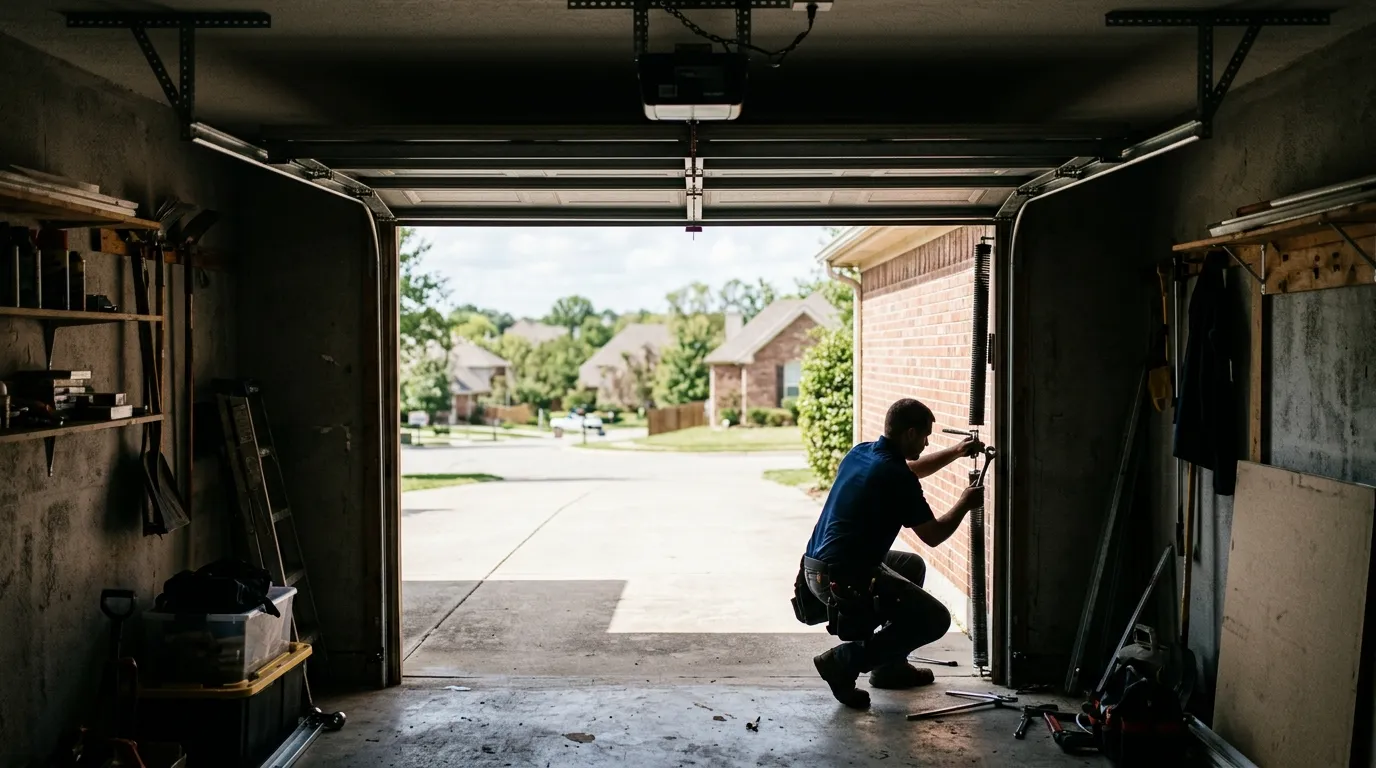
We run out of Sherman, and Bells sits about 12 miles down the road, close enough that a truck already on the way to Denison or Pottsboro can usually swing through the same day. We don't keep a shop or a crew stationed in Bells, so we won't pretend there's a depot around the corner. What we can say is that the drive itself isn't the bottleneck most days - parts availability for an older opener or a discontinued spring size is more often what sets the schedule. If you call and we're mid-job somewhere else on the list, we'll tell you honestly where you land in the queue rather than promise a window we can't hit.
Bells isn't one era of building stacked on itself the way some larger towns are. With 763 households in the area, it's a small enough footprint that a handful of subdivisions from the mid-1980s account for a lot of the doors we see, alongside newer infill built after 2000. That 1985 median build year matters more than it sounds like it should: it puts most garages right at the point where steel sectional doors and chain-drive openers had become standard, but before today's insulated panels and screw-drive or belt systems showed up. So a repair call here is often less about a dead opener board and more about a torsion spring or a track bent from age, on hardware that's been doing its job quietly for close to forty years.
A door installed around 1985 was built to a different set of expectations than one going in today. Panels tend to be thinner steel, insulation (if there's any) is minimal, and the springs were sized for the door weight of that era, not for a heavier retrofit insulated panel someone may have swapped in later without recalculating spring tension. In this cold-moderate climate, temperature swings between summer and winter put real stress on aging torsion springs and rollers that were never rubber-sealed to begin with. That combination - original-era hardware plus real seasonal temperature change - is why the failures we see most in this stretch of houses are spring breaks and roller wear, not opener electronics. Replacing a spring on a 40-year-old door is usually worth doing. Replacing the whole door is worth considering once the track and jambs have shifted enough that a new spring won't hold alignment.
Zoom out to the wider Sherman service area and you're looking at housing built between 1967 and 2005, with a median around 1984 across 14 named communities - Bells sits right in the middle of that range at 1985, not an outlier. Area household income here runs $89,635, higher than the roughly $74,773 median for the broader service area, which tends to show up in the calls we get as more owners opting for full replacement with a better-insulated door rather than patching an old one repeatedly. Across the wider area there are 20,213 households and 10,699 owner-occupied houses, and Bells' 763 households are a small but consistent slice of that. It's a town where the housing is old enough to have real hardware issues, but the households calling us are often ready to invest in doing it right the second time.
No. We work out of Sherman and drive out to Bells, about 12 miles each way. Most jobs still get same-day or next-day service, but we won't claim a local depot we don't have.
A lot of the housing here dates to around 1985, right when steel sectional doors and torsion springs became standard. Forty years of seasonal temperature swings in this cold-moderate climate wear those original springs down, so spring failure is the most common call we get from this area.
Depends on the door. If the track and jambs are still square, a new spring or roller set usually solves it. Once the frame has shifted from age or someone's added a heavier panel without upgrading the spring, repeated patching stops making sense and replacement is the better spend.
Call now or request a free quote - same-day service on most repairs, upfront written pricing.
Denison runs about 10,001 households, which is enough houses that opener failures show up on a regular basis but not so many that this is a high-volume install town for us. Most weeks we're out here for one or two jobs, not a dozen. The install itself is straightforward on paper: pull the dead unit, mount a new motor head, run the rail, set the travel limits, program the safety sensors, pair the remotes. What changes job to job is what's already on the ceiling. In a town where the typical house went up around 1967, that's often a chain-drive unit from a prior generation, bolted to framing that was never meant to carry a modern belt-drive rail bracket. We check the header board before we quote the swap, not after we're already up on the ladder.
The other piece is power. Older garage construction in this area sometimes has a single outlet wired for a light bulb, not a motor. If that's the case here, we'll tell you before we show up with the wrong plug on the unit.
The calls from Denison tend to sound the same: the door won't respond to the remote, or it responds and then reverses halfway up. On a house built around 1967, that's frequently a worn drive gear inside an old chain-drive head, not a bad remote battery - the gear strips slowly over years and the symptom looks electrical when it's mechanical. We also see a fair number of openers here that were never upgraded when the safety-sensor law changed decades back, meaning there's no photo-eye at all. That's not a Denison quirk specifically, but it shows up more in a town with a 1967 median build year than it would somewhere newer.
Cold-weather stalling is the other pattern. This part of Texas sits in a moderate-cold climate band, and an aging opener that's been fine for years can start hesitating on cold mornings once the grease in the drive gear stiffens up. If your door groans open slow in January and fine in July, that's usually the opener telling you it's near the end, not the door.
The trouble spot on older Denison houses is the header - the wood framing above the door opening. A house from 1967 was framed to hold a lighter, hand-operated door, and decades of settling can leave that header out of square. We've had installs where the bracket that should take twenty minutes takes an hour because we're shimming and reinforcing before the rail will sit level. We quote for the standard case and tell you up front if we find something that changes it; we don't padding the estimate for a problem we haven't seen yet.
The other place this goes sideways is wiring an opener into a door that's already got a bad spring or a bent track. An opener can't fix a door that's fighting itself, and putting a new motor on a door with the wrong spring tension just burns out the new motor faster. We won't install an opener on a door that isn't right first - we'll tell you what needs fixing before the motor goes in, even if that means a second visit.
We don't have a set price to quote you here - every job depends on the unit you pick and what we find on the header once we're up there. What we can tell you is how Denison households tend to decide. With median household income here around $60,821, most owners we talk with want the mid-tier belt-drive option: quieter than a chain drive, not the top-shelf smart-connected unit with every feature. That's a reasonable call on a house this age - the extra cost of the premium unit buys features that don't do much for a door and opener setup built to 1967 specs.
We'll give you a firm number after we look at the door in person, not a phone estimate. If your existing rail and track are in good shape, replacing just the motor head costs less than a full new track system, and we'll say so instead of upselling the bigger job.
We travel the 10 miles from Sherman to reach Denison, so the honest limitation here is that we're not a local depot - there's no truck sitting in town waiting on a call. A straightforward motor swap, once we're on site, usually finishes in one visit. If we find header framing that needs reinforcing first, or a spring that has to be replaced before the opener goes in, that can push the job to a second trip. We'll tell you which situation you're in before we start, not after we've billed the first visit.
Usually, yes, if the track and spring are in good shape. What we check first is whether the header framing above the door can safely take a new bracket - on houses built around 1967 that framing sometimes needs reinforcing before the rail goes up.
This area sits in a moderate-cold climate band, and grease inside an aging drive gear stiffens in cold weather. An opener that's already near the end of its life will show that first as slow or hesitant movement on cold mornings, even though it runs fine most of the year.
No. We run out of Sherman, about 10 miles away, and come to Denison for scheduled jobs. We don't advertise a local response time here because we aren't stationed in town.
Given the income levels typical of this area, most owners choose a mid-tier belt-drive unit over the top smart-connected model. It's a reasonable match for houses built in this era - the extra features on premium units don't add much value on older door and track setups.