Sherman, TX · Garage Door Service
Panel replacement for Bells homes, most built in the mid-1980s. We travel the 12 miles from Sherman with the steel panel sizes this era of door actually uses.
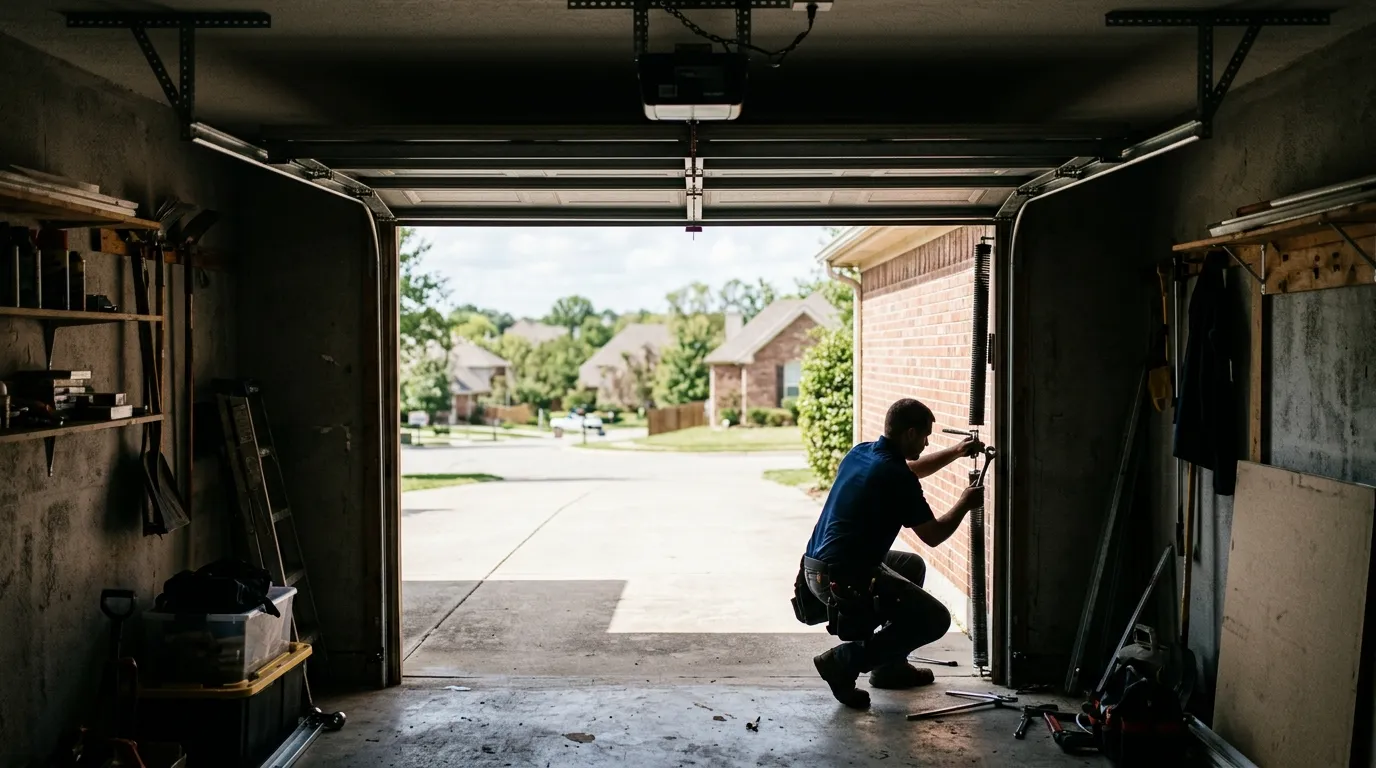
We run out of Sherman, and Bells sits about 12 miles down the road, close enough that a truck already on the way to Denison or Pottsboro can usually swing through the same day. We don't keep a shop or a crew stationed in Bells, so we won't pretend there's a depot around the corner. What we can say is that the drive itself isn't the bottleneck most days - parts availability for an older opener or a discontinued spring size is more often what sets the schedule. If you call and we're mid-job somewhere else on the list, we'll tell you honestly where you land in the queue rather than promise a window we can't hit.
Bells isn't one era of building stacked on itself the way some larger towns are. With 763 households in the area, it's a small enough footprint that a handful of subdivisions from the mid-1980s account for a lot of the doors we see, alongside newer infill built after 2000. That 1985 median build year matters more than it sounds like it should: it puts most garages right at the point where steel sectional doors and chain-drive openers had become standard, but before today's insulated panels and screw-drive or belt systems showed up. So a repair call here is often less about a dead opener board and more about a torsion spring or a track bent from age, on hardware that's been doing its job quietly for close to forty years.
A door installed around 1985 was built to a different set of expectations than one going in today. Panels tend to be thinner steel, insulation (if there's any) is minimal, and the springs were sized for the door weight of that era, not for a heavier retrofit insulated panel someone may have swapped in later without recalculating spring tension. In this cold-moderate climate, temperature swings between summer and winter put real stress on aging torsion springs and rollers that were never rubber-sealed to begin with. That combination - original-era hardware plus real seasonal temperature change - is why the failures we see most in this stretch of houses are spring breaks and roller wear, not opener electronics. Replacing a spring on a 40-year-old door is usually worth doing. Replacing the whole door is worth considering once the track and jambs have shifted enough that a new spring won't hold alignment.
Zoom out to the wider Sherman service area and you're looking at housing built between 1967 and 2005, with a median around 1984 across 14 named communities - Bells sits right in the middle of that range at 1985, not an outlier. Area household income here runs $89,635, higher than the roughly $74,773 median for the broader service area, which tends to show up in the calls we get as more owners opting for full replacement with a better-insulated door rather than patching an old one repeatedly. Across the wider area there are 20,213 households and 10,699 owner-occupied houses, and Bells' 763 households are a small but consistent slice of that. It's a town where the housing is old enough to have real hardware issues, but the households calling us are often ready to invest in doing it right the second time.
No. We work out of Sherman and drive out to Bells, about 12 miles each way. Most jobs still get same-day or next-day service, but we won't claim a local depot we don't have.
A lot of the housing here dates to around 1985, right when steel sectional doors and torsion springs became standard. Forty years of seasonal temperature swings in this cold-moderate climate wear those original springs down, so spring failure is the most common call we get from this area.
Depends on the door. If the track and jambs are still square, a new spring or roller set usually solves it. Once the frame has shifted from age or someone's added a heavier panel without upgrading the spring, repeated patching stops making sense and replacement is the better spend.
Call now or request a free quote - same-day service on most repairs, upfront written pricing.
Bells sits about 12 miles out from our shop in Sherman, and that drive shapes how a panel call here actually works: we're not swinging by on a whim, so when you call we want to know the door's age and the damage before a truck rolls. Most houses in Bells went up around 1985, which puts them square in the middle of the 1967-2005 window that covers most of this service area's housing stock. That means a lot of Bells garages still carry the same steel raised-panel doors that came standard through the 80s and 90s - wide flat sections, roll-formed edges, and section heights that don't always match what's sold off the shelf today. A cracked or caved-in panel on one of these doors is almost never cosmetic only. The section carries the track rollers on either side, and once it's bent, the door can bind or walk out of its tracks even if the opener still runs fine. What you're seeing - a dented bottom section from a bumper tap, a split panel from a wind-driven branch, rust blistering through the paint near the bottom seam - tells us which of these doors we're dealing with before we ever get in the truck.
Since we're coming from Sherman, we ask for a few things up front so the trip counts: the door's approximate age, whether it's a one-piece or sectional door, and a photo of the damaged panel if you can get one. That last part matters more here than it might elsewhere - Bells doors from the mid-1980s often used panel widths and hinge spacing that changed by the early 90s, so knowing which era we're matching against saves a wasted first visit. Call or use the contact page for Bells and tell us what you're seeing. We'll ask about the opener too, since a bent panel sometimes means a bent track, and that changes the job. We don't keep a stocked branch in Bells - every job here starts as a drive from Sherman - so a clear description on the front end means the truck that shows up has the right panel, not a guess. Learn more about how we handle service to this area on our [Bells garage doors page](/bells-garage-doors/).
On a sectional door, replacing one panel means unbolting the damaged section's hinges from the sections above and below it, disconnecting the track rollers on both sides, and sliding the new section into place without pulling the whole door apart. If the bent section carries the bottom roller, we check the track alignment on both sides before reinstalling - a panel replacement on a door that's still tracking crooked just fails again in a season. For doors from the mid-1980s stock common in Bells, we also check whether the hinges are the original stamped-steel type or a later replacement, since mixing hardware generations on one door is a common cause of a section that won't sit flush after a repair. If the springs were sized for the original panel weight and the new section is noticeably heavier or lighter - which happens when insulated replacement panels go on an old uninsulated door - we adjust spring tension so the opener isn't straining against a door that's out of balance.
We stock the steel raised-panel sizes and hinge sets that match doors from the 1970s through the 2000s, which covers the bulk of what's on the road out to Bells. What we don't carry on the truck is an exact color or panel-window match for every manufacturer that ever sold in this area - if your door has a discontinued panel style or a decorative window insert, that part sometimes has to be special-ordered, and that's a lead time we're upfront about rather than promise around. For the common case - a plain steel panel on a 1980s or 90s sectional door - we can usually match section height and hinge spacing without a special order. If your door turns out to be a one-piece design rather than sectional, panel replacement isn't really an option; the whole door is one unit, and we'll tell you that instead of trying to patch a section that doesn't come apart.
Swapping a single panel is within reach for someone comfortable with a socket wrench and patient about track alignment, provided the door is unplugged from the opener and the springs are left alone - torsion springs under tension are not a DIY step, full stop. Where homeowners get into trouble is matching panel dimensions on an older door: a section that's an inch off in height will bind against the ones next to it, and a mismatched hinge gauge can pull loose within a year. If your Bells house still has its original 1980s-era door and you're not sure the replacement panel you found actually matches the section height, it's worth a call before you cut into the old one - once the damaged section is removed, an ill-fitting replacement is harder to walk back than the original repair would have been.
No. We run out of Sherman, about 12 miles away, and every Bells job starts as a drive from there. We don't promise a set response time for that reason, but we do ask for photos and door details up front so the trip is planned around the right parts.
Usually, yes. Most Bells houses were built around 1985, right in the range of steel raised-panel doors we stock sizes and hinges for. Exact color or decorative window matches on older doors sometimes need a special order, which we'll tell you about before starting the job.
It can. The panel carries the track rollers, so a bent section sometimes means the track has shifted too. We check alignment on both sides before calling the job done, since a new panel on a crooked track will just bend again.
No. One-piece doors are a single unit, not separate sections, so there's no individual panel to swap out. If that's what you have, replacement means the whole door, and we'll say so rather than try to patch a section that doesn't separate.