Sherman, TX · Garage Door Service
Bells homes built mid-1980s often carry the original steel door and worn extension springs. We install new doors sized for that era's openings, 12 miles from Sherman.
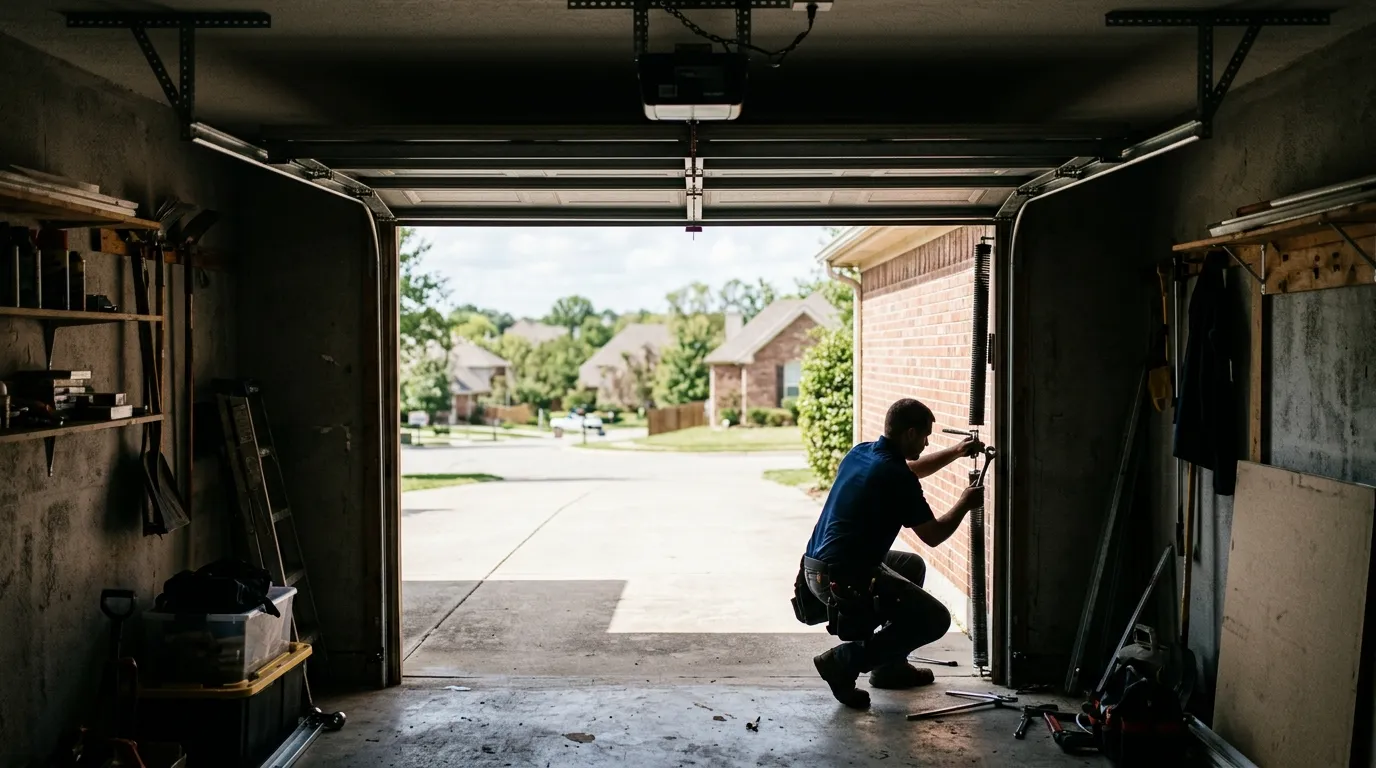
We run out of Sherman, and Bells sits about 12 miles down the road, close enough that a truck already on the way to Denison or Pottsboro can usually swing through the same day. We don't keep a shop or a crew stationed in Bells, so we won't pretend there's a depot around the corner. What we can say is that the drive itself isn't the bottleneck most days - parts availability for an older opener or a discontinued spring size is more often what sets the schedule. If you call and we're mid-job somewhere else on the list, we'll tell you honestly where you land in the queue rather than promise a window we can't hit.
Bells isn't one era of building stacked on itself the way some larger towns are. With 763 households in the area, it's a small enough footprint that a handful of subdivisions from the mid-1980s account for a lot of the doors we see, alongside newer infill built after 2000. That 1985 median build year matters more than it sounds like it should: it puts most garages right at the point where steel sectional doors and chain-drive openers had become standard, but before today's insulated panels and screw-drive or belt systems showed up. So a repair call here is often less about a dead opener board and more about a torsion spring or a track bent from age, on hardware that's been doing its job quietly for close to forty years.
A door installed around 1985 was built to a different set of expectations than one going in today. Panels tend to be thinner steel, insulation (if there's any) is minimal, and the springs were sized for the door weight of that era, not for a heavier retrofit insulated panel someone may have swapped in later without recalculating spring tension. In this cold-moderate climate, temperature swings between summer and winter put real stress on aging torsion springs and rollers that were never rubber-sealed to begin with. That combination - original-era hardware plus real seasonal temperature change - is why the failures we see most in this stretch of houses are spring breaks and roller wear, not opener electronics. Replacing a spring on a 40-year-old door is usually worth doing. Replacing the whole door is worth considering once the track and jambs have shifted enough that a new spring won't hold alignment.
Zoom out to the wider Sherman service area and you're looking at housing built between 1967 and 2005, with a median around 1984 across 14 named communities - Bells sits right in the middle of that range at 1985, not an outlier. Area household income here runs $89,635, higher than the roughly $74,773 median for the broader service area, which tends to show up in the calls we get as more owners opting for full replacement with a better-insulated door rather than patching an old one repeatedly. Across the wider area there are 20,213 households and 10,699 owner-occupied houses, and Bells' 763 households are a small but consistent slice of that. It's a town where the housing is old enough to have real hardware issues, but the households calling us are often ready to invest in doing it right the second time.
No. We work out of Sherman and drive out to Bells, about 12 miles each way. Most jobs still get same-day or next-day service, but we won't claim a local depot we don't have.
A lot of the housing here dates to around 1985, right when steel sectional doors and torsion springs became standard. Forty years of seasonal temperature swings in this cold-moderate climate wear those original springs down, so spring failure is the most common call we get from this area.
Depends on the door. If the track and jambs are still square, a new spring or roller set usually solves it. Once the frame has shifted from age or someone's added a heavier panel without upgrading the spring, repeated patching stops making sense and replacement is the better spend.
Call now or request a free quote - same-day service on most repairs, upfront written pricing.
Most houses in Bells went up around 1985, which puts them squarely in the mid-80s builder-grade wave that ran across this part of the county. That means a lot of these garages still have their original door: a single-layer steel panel, no insulation, hung on extension springs bolted above the track rather than a torsion bar overhead. Thirty-plus years in is close to the end of the road for that hardware, even if the door still looks straight.
The fault we see most in this batch of homes isn't a dramatic spring snap - it's the slow kind. Track brackets pull loose from framing that's shrunk a little over the decades, rollers wear oval instead of round, and the door starts binding on one side before anyone notices. By the time an owner calls, the door is already fighting the opener every cycle, which is what burns out gear sets and drive belts early. New installation here isn't cosmetic - it's swapping out a door and hardware set that was never built for a fourth decade of daily use.
We run this job out of Sherman, about 12 miles up the road, so there's no branch or drop-in counter in Bells itself - you call or book online and we schedule the truck out to you. Because we're traveling in for the appointment, it helps to have the make and rough age of your current door ready when you call, along with whether it's a single or double bay. That lets us load the right door and opener bracket kit before we leave the shop instead of guessing on site.
We don't quote a fixed response window for outlying stops like Bells - drive time is part of the math - but we'll give you a real appointment slot when you call, not a vague callback promise.
A straight installation on an 80s-era Bells garage usually starts with pulling the old track and springs entirely rather than trying to reuse them - the spring wind and drum sizing on a door that age rarely matches what a new door needs, and mixing old hardware with a new panel is how you get a door that won't balance right. We set new track, torsion hardware in place of the old extension springs where the header will take it, and a new opener bracket rated for the door weight you're putting in, not the one that was there.
Insulation is the other piece worth deciding up front. None of the original mid-80s doors in this area came with any foam in the panel, so if you're replacing one now, you're choosing between a bare steel skin like before or a insulated panel - that decision affects both the weight the springs need to carry and how much temperature swing gets into the garage on the colder stretches of a Texas Panhandle winter.
We stock the track, drum, cable, and torsion spring sizes that match the door widths common in this batch of housing - mostly 8 and 9-foot single bays and 16-foot doubles, sized to the openings builders used through the 80s and 90s across the wider Sherman service area. Panel doors themselves we order to the job rather than keep sitting on shelves, since color and insulation choice vary house to house.
One limitation worth being straight about: if your opening is a nonstandard width - something an old addition or a hand-built garage might have - we may need to order that panel size rather than install it same-visit. We'll tell you that on the estimate, not after we've already pulled your old door off the hinges.
A homeowner who's handy can swap weatherstripping or a roller without much risk. A full door and track replacement is a different job - torsion springs on these older Bells setups are wound tight enough to hurt someone badly if the winding bars slip, and getting the header bracket load-rated correctly matters more than it looks like it should. If you're set on doing it yourself, at minimum have someone else on site and don't attempt the spring winding solo.
Where we'd tell you to just call rather than try it: any door where the springs are original to a mid-80s house. Thirty-eight years of cycling steel is not something to guess the wind tension on.
Housing in Bells is mostly mid-1980s, with a median build year around 1985, so if your door has never been replaced it's probably an original single-layer steel panel on extension springs - hardware that's now closer to 40 years old than 20.
No. We work out of Sherman and drive out to Bells for each job, about a 12-mile trip. There's no local branch here, so scheduling is done by phone or online and the truck comes to you.
Usually yes if your opening is a standard 8, 9, or 16-foot width, which covers most homes built in this era. Nonstandard openings from additions or hand-built garages sometimes need a special-order panel, which we'll flag on the estimate.
Worth considering. None of the original 80s-built doors in this area had foam insulation, so replacing one is your chance to add it. It adds weight the springs need to handle but cuts down on temperature swing into the garage.