Sherman, TX · Garage Door Service
Bells homes built around 1985 mean 1980s torsion hardware, not the older stock you'd find closer to Sherman. We drive the 12 miles out with the right parts.
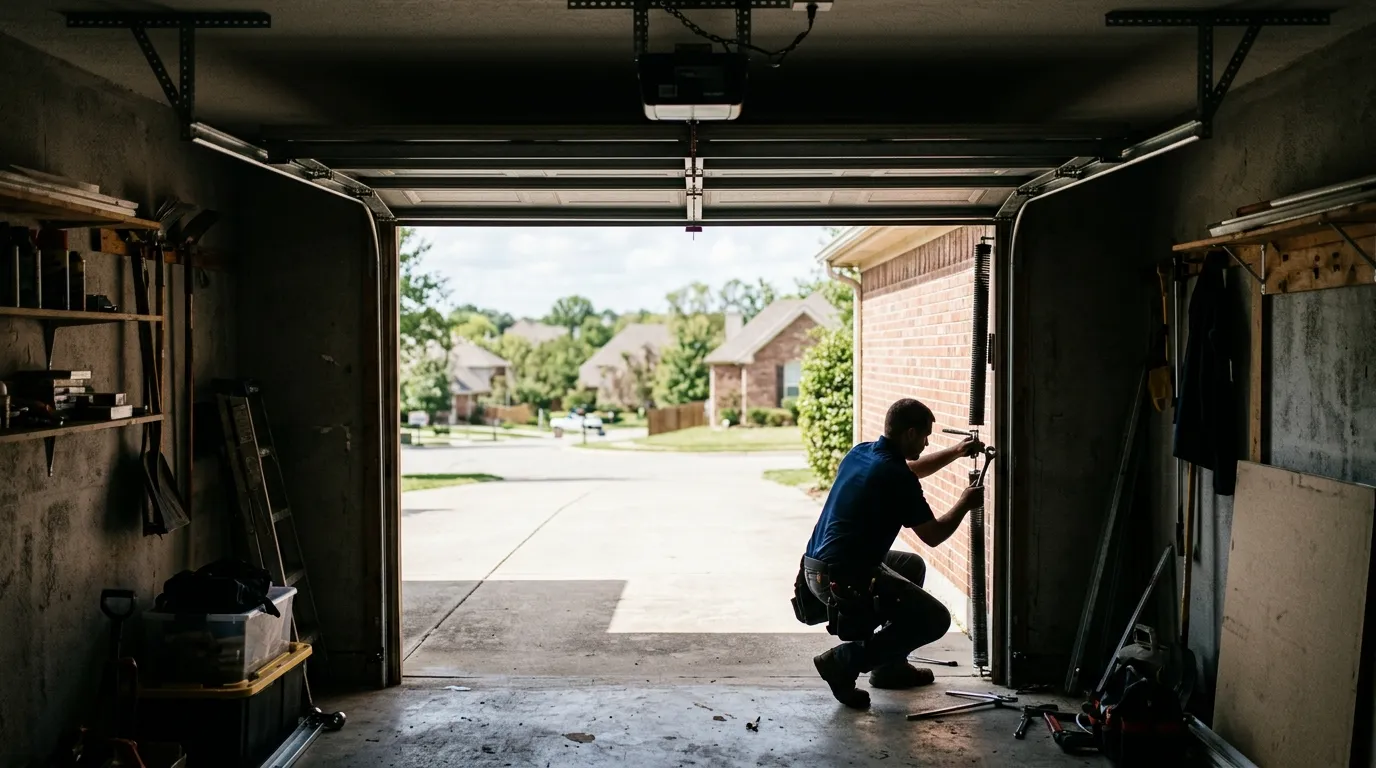
We run out of Sherman, and Bells sits about 12 miles down the road, close enough that a truck already on the way to Denison or Pottsboro can usually swing through the same day. We don't keep a shop or a crew stationed in Bells, so we won't pretend there's a depot around the corner. What we can say is that the drive itself isn't the bottleneck most days - parts availability for an older opener or a discontinued spring size is more often what sets the schedule. If you call and we're mid-job somewhere else on the list, we'll tell you honestly where you land in the queue rather than promise a window we can't hit.
Bells isn't one era of building stacked on itself the way some larger towns are. With 763 households in the area, it's a small enough footprint that a handful of subdivisions from the mid-1980s account for a lot of the doors we see, alongside newer infill built after 2000. That 1985 median build year matters more than it sounds like it should: it puts most garages right at the point where steel sectional doors and chain-drive openers had become standard, but before today's insulated panels and screw-drive or belt systems showed up. So a repair call here is often less about a dead opener board and more about a torsion spring or a track bent from age, on hardware that's been doing its job quietly for close to forty years.
A door installed around 1985 was built to a different set of expectations than one going in today. Panels tend to be thinner steel, insulation (if there's any) is minimal, and the springs were sized for the door weight of that era, not for a heavier retrofit insulated panel someone may have swapped in later without recalculating spring tension. In this cold-moderate climate, temperature swings between summer and winter put real stress on aging torsion springs and rollers that were never rubber-sealed to begin with. That combination - original-era hardware plus real seasonal temperature change - is why the failures we see most in this stretch of houses are spring breaks and roller wear, not opener electronics. Replacing a spring on a 40-year-old door is usually worth doing. Replacing the whole door is worth considering once the track and jambs have shifted enough that a new spring won't hold alignment.
Zoom out to the wider Sherman service area and you're looking at housing built between 1967 and 2005, with a median around 1984 across 14 named communities - Bells sits right in the middle of that range at 1985, not an outlier. Area household income here runs $89,635, higher than the roughly $74,773 median for the broader service area, which tends to show up in the calls we get as more owners opting for full replacement with a better-insulated door rather than patching an old one repeatedly. Across the wider area there are 20,213 households and 10,699 owner-occupied houses, and Bells' 763 households are a small but consistent slice of that. It's a town where the housing is old enough to have real hardware issues, but the households calling us are often ready to invest in doing it right the second time.
No. We work out of Sherman and drive out to Bells, about 12 miles each way. Most jobs still get same-day or next-day service, but we won't claim a local depot we don't have.
A lot of the housing here dates to around 1985, right when steel sectional doors and torsion springs became standard. Forty years of seasonal temperature swings in this cold-moderate climate wear those original springs down, so spring failure is the most common call we get from this area.
Depends on the door. If the track and jambs are still square, a new spring or roller set usually solves it. Once the frame has shifted from age or someone's added a heavier panel without upgrading the spring, repeated patching stops making sense and replacement is the better spend.
Call now or request a free quote - same-day service on most repairs, upfront written pricing.
Bells sits about 12 miles from our shop in Sherman, and the houses out here were mostly built right around 1985 - almost dead center on the build-year median for the whole service area, which runs from 1967 to 2005. That matters more than it sounds like it should. A door installed in 1985 is old enough that the original springs and openers are long gone, but the track and header framing are still that era's standard width. When we get a call from Bells, we're not guessing at a house built in the 1950s with oddball hardware, and we're not walking into a 2015 build with a smart opener already installed. We know what's behind the door before we open the truck.
With 763 households in Bells and a median income of $89,635 - noticeably higher than the $74,773 median across the wider service area - a fair number of these garage doors have already been upgraded once, maybe a new opener swapped in during the 2000s while the original torsion springs stayed put. That's the failure we see most: newer opener, old spring, and the spring finally lets go under a motor it was never sized for.
We work Bells from Sherman, so there's no local branch to call - you're reaching the same crew that covers the rest of the area. Call and tell us what the door is doing: won't open, opens partway and stalls, makes a bang and drops, or the opener runs but the door doesn't move. That last one is almost always a broken cable or a stripped gear, not the motor itself, and telling us which one saves a diagnostic trip.
We don't keep a satellite stock in Bells, so if your door needs a part we don't have loaded on the truck already, we'll tell you that up front rather than show up and discover it on-site. For a 1985-era door that usually means standard torsion springs and rollers we carry as a matter of course - it's the odd-width tracks or discontinued opener boards that sometimes need a second trip.
On a door from this build era, the most common job is a torsion spring replacement. The spring wears out from cycle count, not age on the calendar, so a door that's been used daily since 1985 has likely already had one replacement and is due for another. We measure the shaft, match the wire gauge and wind, and replace both springs on a double door even if only one has broken - the other is close behind it and mismatched springs put uneven load on the shaft.
Cold winters in this part of Texas stiffen up old lubricant and shrink metal tolerances slightly, which is often what finally snaps a spring that was already near the end of its life. We check the cable condition, the roller wear, and the track alignment while we're in there, because on a door this age those parts are usually due for attention even if they haven't failed yet. We won't replace parts that don't need it - if the springs are the only problem, that's the only invoice line.
For the hardware common to Bells' 1980s-era housing stock, we carry standard torsion springs in the wire gauges that fit typical residential shaft sizes from that period, along with rollers, cables, and hinges sized for the same doors. These are the parts that fail from wear on a 35-plus-year-old door and the ones we load on the truck as routine stock.
What we don't carry as standard stock: opener control boards for openers that have been discontinued, and non-standard track hardware from a handful of manufacturers that stopped making replacement parts years ago. If your door has one of those, we'll tell you on the first visit and talk through whether it's worth sourcing the part or replacing the unit outright.
Don't touch a broken torsion spring yourself. It's under enough tension to break a bone or worse, and that's true whether the door is from 1965 or 2005. Roller replacement and basic track cleaning are reasonable DIY jobs if you're comfortable with hand tools and the door is currently working.
Where it stops making sense to fix rather than replace: if the door itself is original from the mid-1980s and the panels are dented, warped, or rusted through at the bottom, a spring or cable repair buys you a working door on failing panels. At that point we'll say so plainly rather than keep patching a door that's on its way out.
No. We're based in Sherman and drive out to Bells for every call - about 12 miles. There's no local depot, so parts we don't carry on the truck may mean a short second visit rather than a same-day fix.
Cold weather stiffens old lubricant and tightens metal tolerances slightly, which adds stress to a spring that's already near the end of its cycle life. In a climate with a real cold season, that's often the final push on a spring that was going to fail soon anyway.
Houses in Bells were mostly built around 1985, so a lot of doors have already had at least one opener or spring swap since original construction. Original panels from that era are less common but not rare, especially on doors that haven't seen heavy daily use.
We carry standard rollers, cables, and torsion springs that fit typical 1980s-era residential doors. Discontinued opener control boards and unusual track hardware from that period aren't stock items, and we'll tell you upfront if your door needs one.